
Leadership Means Picking Winnable Fights, Not Flaming Out for a Headline: McKinney Had No Path
McKinney's mosque vote was decided weeks before the outrage arrived. This piece argues conservative leadership means aiming energy at fights that can actually be won: zoning code, utility districts, funding disclosure, not just the ones that make headlines.
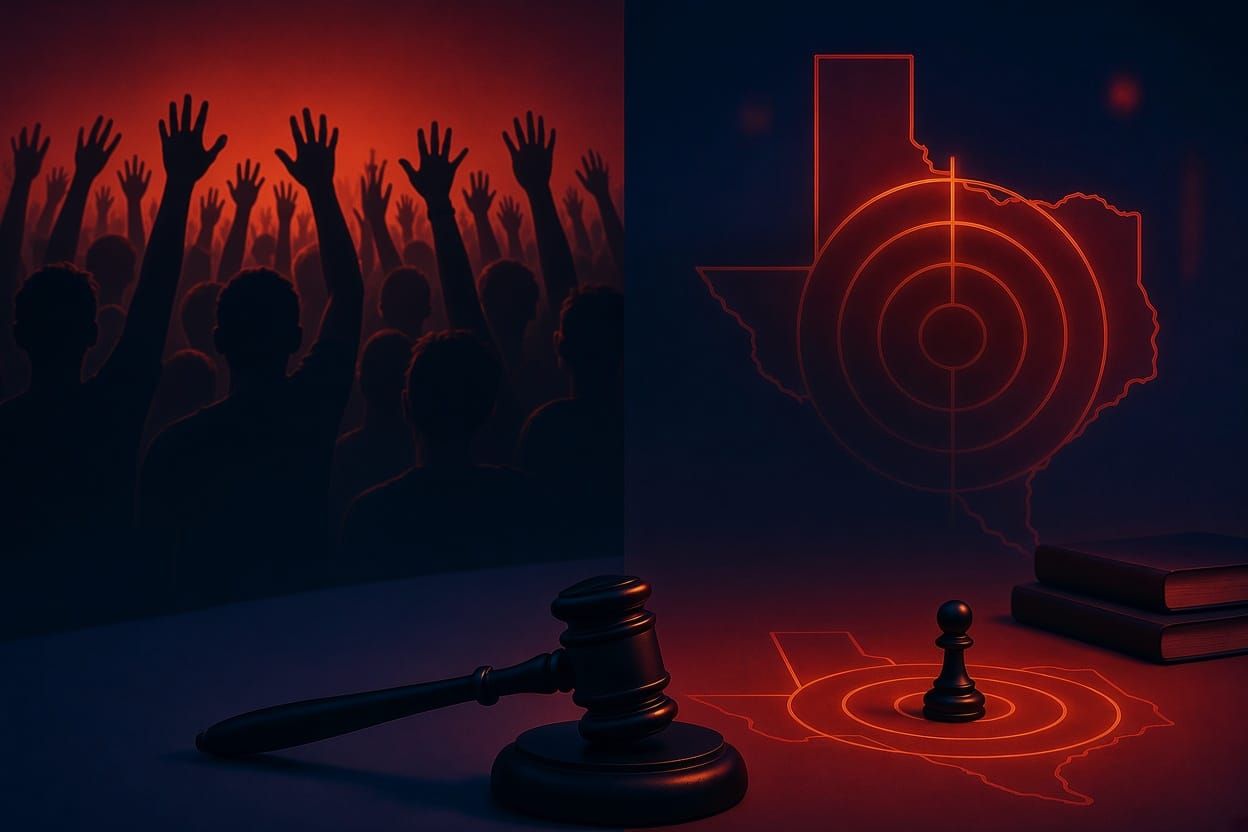
By the time McKinney's city council chambers filled past capacity on the night of August 5, the fight had already left McKinney. U.S. Rep. Keith Self posted a warning to constituents on X days ahead of the vote, national accounts picked it up, and by the time the gavel hit the table, more than 150 people had signed up to speak, overflowing into a second room and the hallways of City Hall. The meeting ran past 11:30 p.m. amid boos, cheers, and shouting over Sharia law, religious liberty, and parking. At one point, a woman stuffed a "Don't Sharia My Texas" sign into former Mayor George Fuller's shirt as he left the chamber, and police walked him out to make sure he got to his car safely. Online, the reaction was louder still: timelines full of calls to flood the meeting, clip compilations, and commentary from accounts with no connection to Collin County at all.
Then the McKinney City Council voted 7-0 to approve the site plan anyway. The vote wasn't close, and it was never going to be. Planning and Zoning had already signed off unanimously, without discussion, on July 14, weeks before the online temperature started climbing. City officials weren't hiding their reasoning: they said flatly they had no legal power to say no.
That's the pattern worth examining, and it's a leadership pattern, not a grassroots one. A sitting congressman's warning is what turned a routine, already-decided zoning formality into a statewide cause. That's not a knock on the instinct to fight. It's a question of aim. When a leader points the base at a fight before checking whether the fight is winnable, the base shows up, loses, and walks away having learned the wrong lesson: that showing up doesn't work. The lesson should have been that leadership picked the wrong target.
None of what follows is aimed at Self, or at anyone else who showed up, spoke up, or amplified this fight. This is a critique meant to strengthen the cause, not infighting against the people carrying it. Getting the base energized is genuinely valuable, and it isn't something to talk anyone out of. But energy needs a destination. The achievable win has to be identified before the catalyst goes out, not after a crowd has already been mobilized to show up for a vote that was decided weeks earlier.
Start with what's real here. The concern underneath all that public comment (that Islamic institutions are expanding across North Texas faster than most residents have registered, with real long-term questions about assimilation, parallel legal norms, and social cohesion) isn't manufactured, and it shouldn't be dismissed as bigotry by people who'd rather not discuss it. That conversation is legitimate and worth having.
McKinney wasn't, at all, the wrong place to have that conversation. This specific vote was the wrong target, because the outcome was already defined before anyone signed up to speak. Once a compliant site plan is on the table, there's no decision left to influence, only a formality, and a formality is not a winnable path.
Why McKinney Had No Winnable Path
In 2024, the McKinney Islamic Association asked the city to rezone the same parcel for a 40,000-square-foot building. That required a discretionary rezoning, and the city had real authority there. Planning and Zoning killed it, unanimously, citing size and parking. Then-P&Z chairman Bill Cox, now McKinney's mayor, put it plainly: "It's just too big of a building for that site."
The association came back with a smaller plan that fits the parcel's existing zoning: no rezoning, no variance, no special exception. Once an application meets every objective standard already on the books, Texas municipal law treats approval as ministerial, an up-or-down check against a checklist, not a policy judgment. Councilman Patrick Cloutier said as much on the record: "If they build to that zoning specifically, with no variations, this council and P&Z have no power to stop them. What we have to do is give site plan approval in a ministerial way, where we just say, okay. What if we say no? They're going to sue us, and they're going to win, and they're going to build it anyway, and we're going to pay legal fees."
He wasn't being generous to the mosque. He was describing the Religious Land Use and Institutionalized Persons Act (RLUIPA), the federal law that lets the Justice Department sue municipalities that single out religious institutions for treatment other assembly uses wouldn't get. It has teeth. Bernards Township, New Jersey fought a mosque denial and settled for $3.25 million plus a forced rewrite of its zoning ordinance. Des Plaines, Illinois settled a similar case after denying a mosque conversion. Broken Arrow, Oklahoma is in a live RLUIPA fight right now after denying a mosque rezoning. CAIR and the Islamic Society of Tulsa sued, and DOJ is reportedly circling.
Compare that to Hoover, Alabama, where planning staff recommended denying an Islamic academy's rezoning on the record for failing to align with the comprehensive plan and for unresolved traffic and occupancy problems: objective, secular grounds that had nothing to do with who the applicant was. The academy withdrew rather than fight it. Lancaster County, South Carolina did the same with a proposed mosque near Indian Land, voting down the permit after two hours of public opposition.
The underlying anxiety was the same in all four cities. Only Hoover and Lancaster County had actual legal ground to stand on. McKinney didn't, and Broken Arrow is finding out the hard way what happens when a city assumes it does anyway.
Leadership Means Aiming the Fight, Not Just Amplifying It
This is where the McKinney backlash goes wrong, and it's worth saying plainly: showing up furious to a hearing the city has already told you it has no legal discretion over doesn't move anything. It doesn't stop the building. It hands the other side a news cycle where the story becomes "angry crowd, powerless officials, mosque approved anyway," a story that makes the concern itself look unserious, because it was spent on a fight nobody could win.
The responsibility for that sits with leadership, not with the residents who showed up. An individual voter can't be expected to know the difference between a ministerial site-plan approval and a discretionary rezoning. That's a niche legal distinction, and city officials only explained it once the outrage was already rolling. Elected officials, caucus organizers, and commentators with a platform don't have that excuse. Picking winnable fights is the actual job. A congressman, a state party, a movement organization exist to do the diligence a busy voter can't: know which hearings are theater and which ones have a lever attached, and spend the base's attention accordingly. That diligence has to come first. The energy itself isn't the problem; it's the fuel the whole movement runs on. The problem is releasing it before an achievable win has been identified, instead of after. When leadership skips that step and just amplifies whatever generates the most engagement, it isn't leading. It's redirecting energy toward the loudest option instead of the winnable one.
Part of the broader dissatisfaction voters feel toward elected officials traces back to exactly this pattern. To be clear, that isn't a claim about any single leader's motives. Firing up a crowd builds a politician's name, generates clips, and fills a fundraising list, whether or not the fight was ever winnable, and that happens even when the leader genuinely believes in the cause. Voters show up, spend their energy, and get a headline for the politician instead of a result for themselves. Do that enough times, even with good intentions, and "fighting for you" starts to sound less like a plan and more like a fundraising strategy: promises made loudly, with faux delivery, over and over. That erosion of trust doesn't stay contained to any one issue either. Institutions don't survive on energy alone. They survive on results, and a pattern of energy without results is what wears institutions down from the inside over time. Politics without a virtuous result stops functioning as persuasion and starts functioning as gaslighting for attention, whether or not that's ever the intent. Naming that pattern is the point of raising it here: not to relitigate McKinney or any one leader's choices, but to make sure the next fight actually delivers something for the people who showed up to it.
There's a related cost at the institutional level, not just the personal one. Every time a city council watches four hours of public comment produce a unanimous vote in the opposite direction, it learns that public objection and legislative outcome are two unrelated events. That lesson doesn't stay contained to zoning. It teaches officials, generally, that the base's leadership cries wolf, and that noise from the right can be absorbed without consequence. That's a credibility account leaders are drawing down every time they point the base at an unwinnable fight, and it's the same account they'll need to be full the next time there's an actual discretionary call: a rezoning vote, a comprehensive-plan hearing, a MUD board appointment, where organized pressure can still change the outcome.
Where the Winnable Fights Actually Are
If leadership is going to point the base somewhere, two things should guide the target. First, look at the pathway, not the building. McKinney isn't an isolated case, it's one node in a broader pattern of Islamic institutional growth moving across North Dallas and North Texas through the same handful of procedural doors: ministerial zoning approvals, utility district annexation, and site plans filed after a rezoning fight already failed.
The pattern is regional, not local to McKinney. The East Plano Islamic Center is trying to build a 400-acre community near Josephine. Princeton Islamic Center is fundraising for an expanded complex. An Islamic academy in Richardson recently acquired a former Baptist church to build a K-12 school, seminary, and mosque, and it's one of dozens of mosques and Islamic centers already operating across Dallas-Fort Worth. Treat each of those as its own local news story and every fight looks like McKinney: a compliant applicant, a foreclosed outcome, and a crowd that shows up too late to change anything. Treat them as one pattern moving through the same procedural pathways, and the zoning code, the utility district rules, and the funding disclosure gap become the actual target, because they're what the pattern depends on.
Second, aim at the pathway itself, not at the people using it. That's not just a tactical point; it's a moral one, and it requires a distinction stated precisely rather than assumed: the difference between Islam as a faith practiced by individual neighbors, and Islam asserted as a governing doctrine that claims authority over law, courts, and civil life. Love the sinner, hate the sin applies here in its most literal sense, and it's a line Christian voices closer to this fight have already drawn explicitly. Lakepointe Church Senior Pastor Josh Howerton has made the distinction his standard framing. In his "Live Free" episode on Islam in America, he summarizes it as Christians must "love Muslims as individuals" while they "oppose Islam as a false religion and ideology." In a 2026 interview, he put it even more directly:
"I love every person that calls himself a Muslim. And I hate Islam because it destroys people and eternities. And I can do both those things. I can love a person and I can hate what I believe is a demonic ideology."
Apologist Wes Huff draws the same line with less pulpit and more footnote. His own speaking material frames his work on Islam as an effort to "better understand what Islam teaches and what Muslims believe in order to interact and impact our Muslim friends, neighbours, and colleagues," language that treats Islam as a system to be examined and Muslims as neighbours to be loved. His critique of that system doesn't pull punches. He has called the Quran a text "built for control", structured, in his words, "to regulate every aspect of life in a way that keeps people under religious authority." Same distinction as Howerton's, aimed at the doctrine rather than the believer, made through apologetics rather than the pulpit.
The family filling out a permit application, the congregation McKinney's own code allowed to build, the individual worshippers who make up the dozens of mosques already across Dallas-Fort Worth: they are neighbors practicing a faith the First Amendment protects, same as anyone else's, and they are not the target. The sin worth opposing is the doctrine, not the believer: Sharia positioned as parallel law, foreign-funded political organizing, utility districts annexed to build civic infrastructure outside normal oversight. Every lever below is built to hit that institutional machinery without touching a single person's right to worship.
These fights aren't hypothetical. They're happening in the same news cycle as McKinney, and they show what picking a winnable fight, instead of flaming out for a headline, actually looks like.
Zoning code, before an application exists. Hoover and Lancaster County won because their objective standards (comprehensive plan alignment, traffic and occupancy thresholds, parking ratios) were already on the books when the application arrived. That's the model: show up for comprehensive plan updates and zoning text amendments, applied neutrally to every large assembly use, before a specific applicant files. Do it after the fact, aimed at one applicant, and it's a RLUIPA lawsuit with your city's name on it.
Infrastructure and governance, not the building. The East Plano Islamic Center's EPIC City development (400-plus acres, over 1,000 homes, a school, and a mosque near Josephine) wasn't stalled by anyone fighting the mosque directly. It stalled because the TCEQ notified the developer in writing that it had never obtained the permits required to begin construction and ordered work halted. It stalled further because Attorney General Ken Paxton sued the Double R Municipal Utility District, alleging its board had been improperly seated by directors who didn't own qualifying property, specifically to annex the EPIC City land and dodge the stricter rules Texas now applies to newly formed utility districts. And it stalled because a Collin County judge issued a temporary injunction freezing the MUD's operations until legally qualified board members could be appointed. None of that touches the mosque's religious character. It's permitting law and utility district governance, which is exactly why it holds up. Compliant site plans are ministerial. MUD board eligibility and TCEQ permits are not.
State legislative action. U.S. Rep. Keith Self's Sharia-Free America Caucus and his legislation barring federal courts from recognizing foreign legal systems that conflict with the Constitution are aimed at the actual legal-parallel-systems concern, not at any single building. That's the same congressman whose McKinney post opened this piece, and it's mentioned here to make the point sharper, not to single him out. It's a reminder that the instinct is right and the aim is what's inconsistent, and it's a mistake almost any leader can make in the moment. The legislation targets the actual mechanism (foreign legal systems operating inside U.S. courts). The X post targeted a building the city had no power to stop. Same leader, same underlying concern, one target with a winnable outcome attached and one without. At the state level, House Bill 4211, signed by Governor Abbott in 2025, bars developers from forcing residents into foreign or religious tribunals to settle disputes, keeping jurisdiction in Texas courts. That's a narrower, more defensible tool than trying to block a building outright. And after the Middle East Forum reported that Texas state agencies had funneled roughly $13 million to mosques and Islamist-linked community groups, state legislators opened inquiries into that funding. That's the kind of follow-the-money scrutiny that actually has subpoena power behind it, unlike a city council with no zoning discretion left to exercise.
Federal immigration policy. If leadership wants to address the growth rate itself, rather than any single building downstream of it, this is the lever with an actual decision-maker attached to it: Congress and the executive branch, not a city council that had no say left by the time anyone showed up to the meeting. Leaders serious about the underlying concern have a genuine legislative fight available here. Leaders looking for a headline don't need one. McKinney already gave them the clip.
Notice what all four of these have in common. None of them require opposing a mosque, a family, or a congregation directly. They oppose a loophole, an improperly seated board, an undisclosed funding stream, a foreign legal system operating inside American courts. That's the difference between a movement fighting for its country and a movement fighting against its neighbors, and it's a difference worth preserving on purpose, not by accident.
McKinney was never going to be stopped, and everyone in that room, including the council members voting for it, knew it going in. The concern that got 150 people to show up isn't the problem. Spending it on a vote that was decided before the meeting started is the problem, and that's a targeting decision leadership made, not a mistake the crowd made on its own.
None of this argues for less energy. It argues for sequencing it correctly: identify the achievable win first, then light the catalyst, not the other way around. The people who run caucuses, run campaigns, and run commentary shops have a resource under their control that a single voter doesn't: where to point the base's attention next. TCEQ letters, MUD board eligibility, comprehensive plan hearings, and funding audits don't trend the way a packed city council chamber does. They also actually work. The measure of good conservative leadership isn't which fight draws the biggest crowd. It's which fight the base can still win by the time it shows up.
Sources
Anderson, Erin. "Proposed McKinney Mosque Moves Forward Despite Opposition." Texas Scorecard, July 23, 2026. https://texasscorecard.com/local/proposed-mckinney-mosque-moves-forward-despite-opposition/
"McKinney City Council Approves Mosque Site Plan After Heated Four-Hour Meeting." Audacy/KRLD, August 5, 2026. https://www.audacy.com/krld/news/local/mckinney-city-council-approves-mosque-site-plan-after-heated-four-hour-meeting
"McKinney Approves Mosque Site Plan After 150 Speakers, Police Intervene During Heated Meeting." Dallas Express, August 2026. https://dallasexpress.com/metroplex/mckinney-approves-mosque-site-plan-after-150-speakers-police-intervene-during-heated-meeting/
"'I Was Taken Aback!' Former McKinney Mayor Addresses Physical Confrontation During Contentious Mosque Expansion Vote." WFAA, August 2026. https://www.wfaa.com/article/news/local/collin-county/former-mckinney-mayor-addresses-physical-confrontation-during-mosque-expansion-vote/287-60b38090-ac93-4263-960a-c1200828d1e6
U.S. Department of Justice, Office of the U.S. Attorney, District of New Jersey. "Bernards Township Settles Federal Civil Suit, Agrees To Allow Islamic Society To Build Mosque." https://www.justice.gov/usao-nj/pr/bernards-township-settles-federal-civil-suit-agrees-allow-islamic-society-build-mosque
U.S. Department of Justice, Office of Public Affairs. "Justice Department and City of Des Plaines, Illinois Settle Lawsuit Over Alleged RLUIPA Violations." https://www.justice.gov/archives/opa/pr/justice-department-and-city-des-plaines-settle-lawsuit-over-alleged-rluipa
"Oklahoma City Sued for Discrimination Over Mosque Denial." AsAmNews, August 5, 2026. https://asamnews.com/2026/08/05/broken-arrow-mosque-rezoning-lawsuit-religious-discrimination-rluipa/
"Denied: Hoover Planning and Zoning to Recommend City Council Deny Islamic Academy of Alabama and Muslim Prayer Center Zoning Request." 1819 News. https://1819news.com/news/item/denied-hoover-planning-and-zoning-to-recommend-city-council-deny-islamic-academy-of-alabama-and-muslim-prayer-center-zoning-request
"Hoover Zoning Board Votes Against Islamic Academy in Meadow Brook Corporate Park." HooverSun. https://hooversun.com/news/hoover-zoning-board-votes-against-islamic-academy-in-meadow-/
"Lancaster County Planning Commission Votes Down Permit for Proposed Mosque." WBTV, April 24, 2026. https://www.wbtv.com/2026/04/24/lancaster-county-rejects-permit-proposed-indian-land-mosque/
"US Rep. Keith Self Unveils Legislation to Ban Sharia Law in American Courts." Texas Scorecard. https://texasscorecard.com/federal/us-rep-keith-self-unveils-legislation-to-ban-sharia-law-in-american-courts/
"EPIC City Project in Collin County TX Can't Begin Without Permits, TCEQ Says." WFAA. https://www.wfaa.com/article/news/local/collin-county/epic-city-project-cant-begin-construction-without-permits-tceq-letter/287-1799657d-67d1-4fc2-a899-7809d9b559c0
Office of the Texas Attorney General. "Attorney General Ken Paxton Sues Municipal Utility District and Board for Their Unlawful Actions Supporting East Plano Islamic Center's Illegal Development." https://www.texasattorneygeneral.gov/news/releases/attorney-general-ken-paxton-sues-municipal-utility-district-and-board-their-unlawful-actions
"Court Temporarily Blocks EPIC City's Utility District." Texas Scorecard. https://texasscorecard.com/local/court-temporarily-blocks-epic-citys-utility-district/
"Religious Property Rights in Texas. Can Government Limit What Is Built?" inforney.com. https://www.inforney.com/local-news/religious-property-rights-in-texas-can-government-limit-what-is-built/article_962d7bfa-2598-4c05-883c-04a7edf59339.html
"Texas State Government Gives $13 Million to Islamist Mosques and Community Groups." Middle East Forum. https://www.meforum.org/fwi/fwi-research/texas-state-government-gives-13-million-to-islamist-mosques-and-community-groups
"Collin County Residents Reject Planned Islamic City." Texas Scorecard. https://texasscorecard.com/local/collin-county-residents-reject-planned-islamic-city/
Princeton Islamic Center. "New Masjid Construction." https://picmasjid.org/new-masjid-construction-2/
"Islamic Academy Acquires Richardson Baptist Church, Plans K-12 School, Seminary, and Mosque." Texas Scorecard. https://texasscorecard.com/local/islamic-academy-acquires-richardson-baptist-church-plans-k-12-school-seminary-and-mosque/
"Masjid Map: Dallas." Fajr Labs. https://www.fajrlabs.com/masjid-map/dallas
Howerton, Josh. "What Christians MUST KNOW about Islam in America." Live Free with Josh Howerton, YouTube. https://www.youtube.com/watch?v=2GuvtmbuEJA
"Texas Pastor: 'Islam is a Demonic Ideology' | Official Preview." Shawn Ryan Show. https://dkexpressions.co.za/dkexp/texas-pastor-islam-is-a-demonic-ideology-official-preview/
"'Quran Was BUILT For CONTROL!' – Wesley Huff Reveals Islam's Rise to Power & Christianity's Decline." YouTube. https://www.youtube.com/watch?v=4omIXTRm384
Huff, Wesley. Speaking bio and talk descriptions. https://www.wesleyhuff.com
Disclosure: The ideas, arguments, and conclusions in this piece are the author’s own. AI was used for research, fact-checking, editing, and production under the AI Use Policy.
Get The Sovereignty Ledger by email
Free. One essay at a time. Unsubscribe whenever.
Get the next essay by email
Free. One essay at a time. Unsubscribe whenever.