
Avoiding the Question: How SCOTUS Just Flattened the 14th Amendment
Six justices ruled against Trump's birthright citizenship order. Only five signed onto the constitutional holding. A close read of what Roberts actually argued, what Thomas's 91-page dissent exposed, and what Congress can no longer fix by statute.
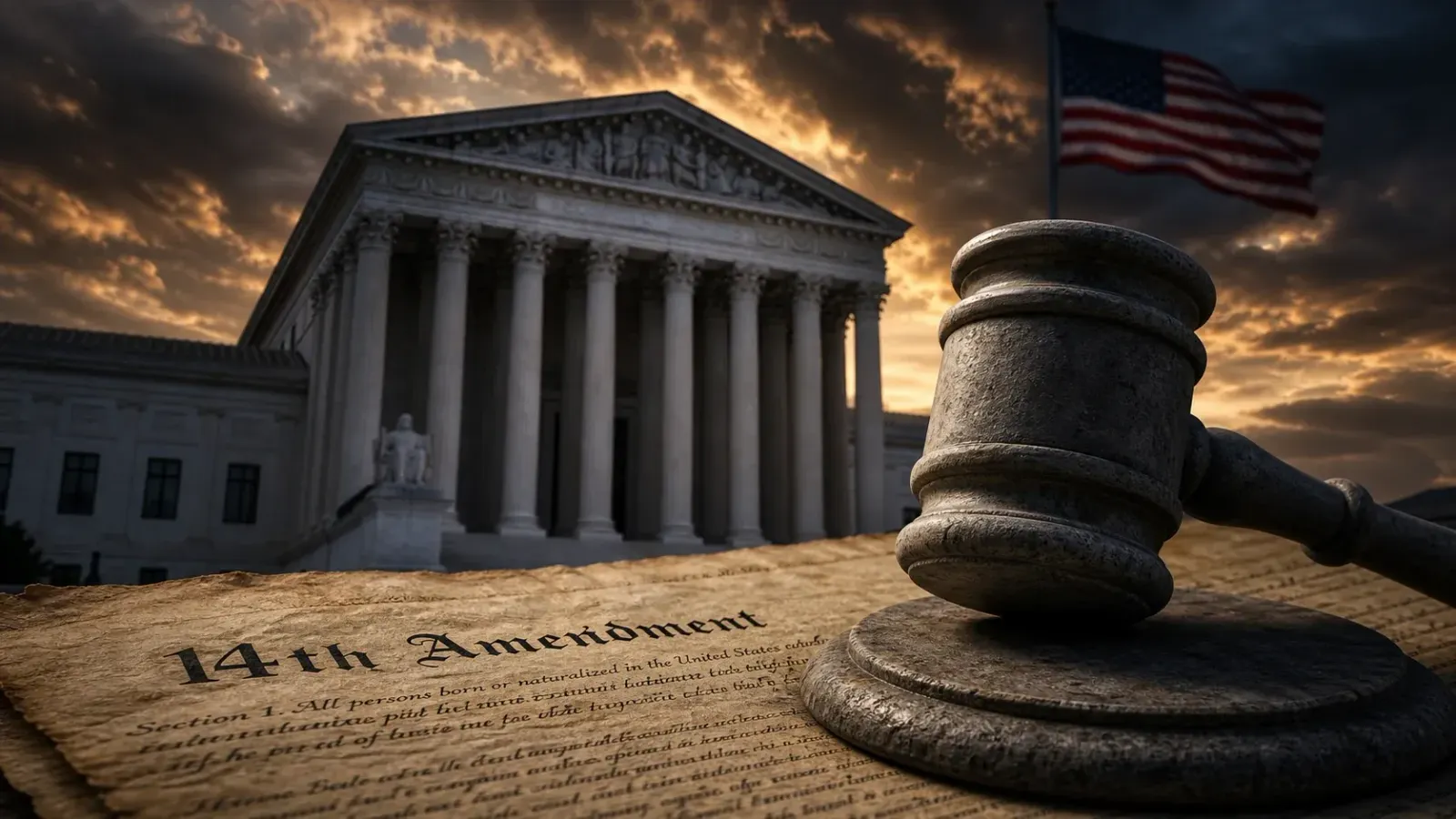
Six justices ruled today that the Constitution requires the United States to grant automatic citizenship to the children of illegal aliens and temporary visitors, no exceptions worth mentioning. In Trump v. Barbara, the Court struck down President Trump's executive order limiting birthright citizenship, with Chief Justice Roberts writing for a majority that treated the question as settled beyond debate — a "promise" made in 1868 that the Court was merely "keeping" today.
Three justices didn't buy it. And their dissents are worth taking seriously, because they rest on the same evidence the majority claims to be reading — the same floor speeches, the same drafting history, the same 1898 precedent — and come out somewhere entirely different.
What the case was actually about
Executive Order 14160 directed federal agencies not to treat children born in the U.S. to parents unlawfully or temporarily present as citizens. Lower courts blocked it immediately, and after a separate ruling curbing nationwide injunctions, the ACLU filed a class action, Barbara v. Trump, that eventually reached the Supreme Court on an expedited basis. The Court heard argument April 1 and issued its ruling June 30, holding flatly that children born in the U.S. to parents unlawfully or temporarily present are "subject to the jurisdiction" of the United States and citizens at birth. A seventh vote, Justice Kavanaugh's, agreed only that the order violates a 1950s-era federal statute, not the Constitution itself, meaning the actual constitutional holding drew support from just five justices. Justices Thomas, Alito, and Gorsuch dissented, each writing separately, with Thomas's dissent running 91 pages.
Senator Jacob Howard's words, and what the majority does with them
The centerpiece of the restrictionist argument has always been Senator Jacob Howard, who introduced the Citizenship Clause on the Senate floor in 1866. The opinion itself quotes him directly: the Clause, Howard said, would not extend to persons who were "foreigners, aliens, who belong to the families of embassadors or foreign ministers." [Slip opinion, at 20] That's the real text, archaic spelling and all. It's worth reading the majority's own treatment of it, because the Court doesn't ignore Howard, it minimizes him. Roberts' opinion concedes Howard's floor statement exists, then immediately characterizes it as one of only "a handful of ambiguous floor statements referencing 'temporary sojourners' and 'foreigners,'" set against what the majority calls "far more frequent and explicit" statements elsewhere in the debates embracing an unqualified common-law rule.
That's the whole ballgame, and it's worth sitting with. The majority isn't claiming Howard said something other than what he said. It's counting statements, treating the debate as a vote tally where the "common law" camp wins on frequency, and Howard's limiting language gets outvoted rather than interpreted. Justice Thomas reads the same debate and draws the opposite conclusion: that "foreigners" and "aliens" were doing real work as separate categories, and that the framers understood citizenship to require something more than physical presence, a genuine, settled membership in the political community, historically captured by the idea of domicile. Thomas's 91-page dissent argues the Citizenship Clause was written to secure the status of the freed slaves and those who shared their circumstances, not to underwrite a system that now extends citizenship to birth tourists and the children of people who crossed the border illegally the week before.
Justice Alito's separate dissent presses the sovereignty point further. He warned that the ruling preserves what he called a powerful incentive to enter or remain in the country illegally, and noted that the "medieval rule" the majority now enshrines has been abandoned even by the United Kingdom, where jus soli originated (the U.K. moved to a parentage-based system in 1983). To be fair to the other side, dozens of countries, mostly in the Americas, still grant unrestricted birthright citizenship, so this isn't strictly a case of the U.S. standing alone. But among peer developed nations outside the Americas, the practice is rare, which is part of why Alito's dissent goes further than a policy quibble. He raises an actual national-security scenario. Imagine, he writes, a child who "never visited the United States while growing up and was inculcated with hatred of this country." Under the majority's rule, that person is still a citizen: he can enter and leave as he pleases, travel on a U.S. passport, and cannot be stripped of citizenship even if he later plots to harm the country.
President Trump's own reaction to the ruling landed on exactly that point, if with less legal precision. Within hours of the decision, he posted...
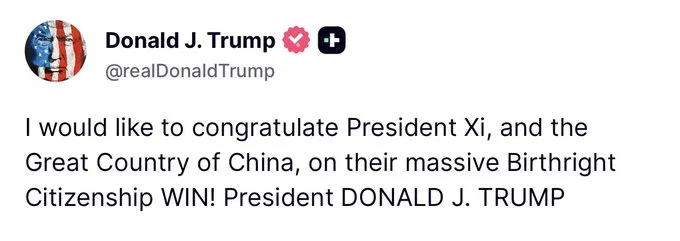
... a jab aimed squarely at Chinese birth-tourism operations that have turned automatic citizenship into a purchasable product for wealthy foreign nationals. He followed up, arguing Congress doesn't need a constitutional amendment to act, and pledged his "Complete and Total Support" for legislation narrowing the practice. Whatever one thinks of the messaging, the underlying sovereignty point tracks Alito's dissent closely, though as the "what this actually costs us" section below explains, the claim that ordinary legislation can now fix this is optimistic in a way the ruling itself doesn't support.
The majority's real move: precedent over original intention
It's worth being precise about how the majority actually gets there, because the opinion doesn't rest on Wong Kim Ark alone. Roberts builds the case in layers: English common law first, then the "subject to the jurisdiction" text itself, read through Chief Justice Marshall's 1812 opinion in Schooner Exchange v. McFaddon, which defined a sovereign's jurisdiction as "full and complete power... within its own territories." Only then does the opinion turn to Wong Kim Ark as confirmation, not foundation.
But look at how the opinion actually frames that confirmation: not as evidence of what the ratifiers meant to do, but as an absence of evidence that they meant to do otherwise. The opinion says Wong Kim Ark's holding "cannot be squared with a domicile requirement," because the Court in 1898 "exhaustively canvassed the text and history" and never identified evidence that the ratifiers meant to impose one. That's a claim about what the historical record fails to show, not a claim about what the framers affirmatively intended. The two are not the same thing, and the majority treats them as interchangeable throughout the opinion.
That's where the sharpest textualist objection lands, too. There's a version of the "just physical presence" critique circulating among legal commentators online: Roberts' opinion effectively collapses "born in the United States" and "subject to the jurisdiction thereof" into a single condition, since under his reasoning mere presence at birth is what makes a person subject to U.S. jurisdiction, making the second clause redundant of the first. The majority actually anticipates this exact charge. The opinion states plainly that the dissent, when it does engage with the operative text, "has little to say," and defends its own reading by pointing to Marshall's Schooner Exchange framework, arguing that temporary presence has always meant full territorial jurisdiction, with only a narrow carve-out for diplomats. That's a real answer, not a dodge. But it's an answer that leans entirely on how jurisdiction was understood in 1812 admiralty law, not on any evidence of what the 1868 ratifiers actually intended by adding "and subject to the jurisdiction thereof" as a second, limiting phrase. That's exactly the gap between text and original intention that Thomas and Alito exploit from the other direction.
The Heritage Foundation has made a related point for years: even under Wong Kim Ark's own logic, the case never resolved citizenship for children of illegal aliens, because that question wasn't before the Court in 1898. Wong's parents were lawfully and permanently domiciled in San Francisco for two decades. Extending that fact pattern to a completely different modern population, Heritage's argument goes, isn't originalism; it's precedent doing the work that evidence of original intention was supposed to do. The majority opinion addresses this directly rather than ignoring it, holding that domicile was never part of Wong Kim Ark's actual reasoning regardless of the facts before it. That's a defensible reading of the case's language. It's a much shakier claim about what the justices who decided Wong Kim Ark, or the Congress that ratified the Fourteenth Amendment thirty years earlier, actually meant to accomplish. Whether that's a fair reading of a 128-year-old opinion or a convenient one is precisely what's still being argued.
The Federalist Society's own treatment of this debate, deliberately structured to present both sides, makes the same observation from a more academic remove: critics of unconditional birthright citizenship have consistently argued that Wong Kim Ark simply didn't involve illegal aliens, and therefore doesn't tell us what the ratifiers intended for the modern question the way the majority assumes. That the Federalist Society felt the need to run "two perspectives" on this at all tells you the originalist case against the majority's reading isn't fringe. It's a live, serious argument among people who take the framers' original intent seriously, not just the surface text.
The John Birch Society's The New American goes further, arguing flatly that the majority's ruling confers citizenship on virtually everyone born here, "including the children of 'birth tourists,'" and that the Fourteenth Amendment, properly understood, confers citizenship only on those who, at birth, owe allegiance solely to this country. Their earlier, more detailed constitutional argument leans on Representative John Bingham, the Fourteenth Amendment's principal House author, who described the citizenship guarantee as covering those born to "parents not owing allegiance to any foreign sovereignty." Whatever one thinks of JBS as an outlet, that reading of Bingham lines up with the allegiance framework Thomas and Alito used in their dissents. It isn't an outlier argument about what the framers meant; it's the mainstream restrictionist one.
This was a bipartisan position, not that long ago
It's worth remembering that restricting birthright citizenship for children of illegal immigrants was, within living memory, a position serious Democrats held too. In September 1993, then-Senator Harry Reid took the Senate floor in support of his own Immigration Stabilization Act, which included a provision, Section 1001, titled "Basis of Citizenship Clarified," declaring that a child born to a mother who was neither a U.S. citizen nor a lawful permanent resident, and who held or was entitled to another country's nationality through a parent, would be considered born outside U.S. jurisdiction for citizenship purposes.
Reid didn't hedge on the floor. "No sane country" would reward illegal entry with citizenship for the resulting child and full access to public services, he said, and pointedly asked whether it was "any wonder that two-thirds of the babies born at taxpayer expense at county-run hospitals in Los Angeles are born to illegal alien mothers."
Dianne Feinstein made a similar case that same year about the abuse of Medicaid by pregnant visitors who gave birth and left (Ironic, isn't it?). Reid's bill died in committee, and he later called it the "low point" of his legislative career and a mistake he didn't fully understand at the time. But he introduced it, defended it at length on the record, and Congress didn't treat the idea as fringe when he did.
Ohio Senator Bernie Moreno has already said he plans to reintroduce Reid's identical 1993 bill language after the July recess, betting that Senate Democrats will be forced to either support the position their own former majority leader once championed or explain, on the record, why it's suddenly disqualifying. That's more a political pressure tactic than a constitutional argument, but it underscores the point above about how recently this was a live, mainstream question rather than the settled matter the majority's opinion treats it as.
What this actually costs us
Set aside the immigration politics for a moment. The deeper problem with today's ruling is what it does to the Court's own claimed method. And this is not the first time Chief Justice Roberts has built the reasoning after deciding the destination, as he did most notably in NFIB v. Sebelius in 2012, the case that saved the Affordable Care Act's individual mandate.
Today's opinion follows a similar pattern in structure if not in politics: a layered argument assembled from common law, 1812 admiralty doctrine, and a reinterpretation of what a 128-year-old precedent's silence means, arranged in whatever order gets the Court to the result it had apparently already settled on. Roberts is not a justice who applies one consistent interpretive method and lets the chips fall. He is a justice who finds the method that produces the institutionally convenient answer, case by case, and dresses it up as continuity with the past.
This majority, including justices who have spent careers insisting that constitutional meaning is fixed at ratification and that policy consequences are Congress's problem, not theirs, reached for administrative continuity over the framers' own, more cautious language. Howard's list of exclusions gets read as narrowly as possible; a 128-year-old precedent involving lawful, permanent residents gets stretched to cover an entirely different population; and the political branches are left with no constitutional tool to respond if birth tourism or deliberate exploitation of the rule ever becomes a serious problem, because the Court has now declared the door permanently open by constitutional command, not statute.
There's a smaller, almost darkly funny fiscal wrinkle worth flagging too. The United States is one of only two countries on Earth (the other being Eritrea) that taxes based on citizenship rather than residency, meaning every person born here owes the IRS an annual return and worldwide-income disclosure for life, regardless of whether they ever set foot in the country again. Combine that with today's ruling and you get, as one commentator put it online, a permanent and rapidly growing population of "accidental Americans" scattered across the globe: people who are U.S. citizens by birth alone, have no idea the IRS considers them delinquent taxpayers, and are one FATCA-triggered bank inquiry away from finding out. This isn't a hypothetical. Tax firms and expat advocacy groups already document tens of thousands of these cases, people who discover their filing obligations only when a foreign bank freezes their account under U.S. financial-reporting law. Unconditional birthright citizenship doesn't just settle who gets to live here, it quietly enrolls people who will never live here into a federal tax and reporting regime most of them will never know exists until it costs them money.
I need to walk back something I said earlier in this piece. I'd framed Kavanaugh's separate opinion as a live path for Congress to legislate new limits on birthright citizenship by statute. That's not right, and a commentator's reaction to the ruling caught the actual mechanics better than I did. As one poster on X put it shortly after the decision came down: the Court could have issued a narrower ruling striking down only the executive order's method, leaving the underlying constitutional question open. Instead it affirmed the broad constitutional right outright, meaning the result can now "essentially only be overturned by a future court." That's the correct read. Kavanaugh agreed the executive order was illegal because it conflicted with a 1940 federal statute, but his was the losing theory. The majority didn't stop at the statute; it went further and held that the Constitution itself guarantees the result. Once five justices say the Fourteenth Amendment requires this outcome, no ordinary act of Congress can un-require it. Congress can pass whatever statute it likes; it would be struck down the same way the executive order was, for the same constitutional reason. The only paths left are a constitutional amendment or a future Court reversing itself, both long shots, and neither available to the current Congress no matter how it votes.
That correction matters, because it sharpens rather than softens the piece's central complaint: this majority didn't just decline to rule narrowly, it went out of its way to foreclose the political branches from revisiting the question at all.
But the constitutional holding itself, five justices, not the "6-3" headline suggests, is a missed opportunity. An honest originalist reading of the Citizenship Clause, one that took Howard's and Bingham's own words as seriously as the majority claims to, would have left room for exactly the kind of limits Thomas and Alito described. Instead, the Court chose the version of the Fourteenth Amendment that's easiest to administer over the version its framers actually wrote.
None of that changes the practical result today: the executive order is dead, and birthright citizenship remains the law as practiced for the last 128 years.
It's also worth resisting the "9-0 to 6-3" framing that's dominated the headlines. Going into today, most of the legal academy treated the administration's position as fringe, and expected a unanimous or near-unanimous rejection. Instead, three justices dissented outright, and a fourth, Kavanaugh, declined to join the majority's constitutional holding at all, resolving the case on statutory grounds instead. Count it up and only five of nine justices were willing to say the Constitution itself compels unconditional birthright citizenship. That's a real shift from where this argument stood a decade ago, when no administration had even attempted to challenge the practice. SCOTUSblog's own reporting confirms the distinction, noting explicitly that Kavanaugh 'agreed with the result... but not its reasoning' and declined to join the constitutional holding, resolving the case on statutory grounds alone.
But Thomas warned in his dissent that he isn't sure the majority's opinion will stand the test of time, and after today, that's no longer an idle prediction. It's a vote count with a plausible path to five.
Sources
- Supreme Court of the United States, Trump v. Barbara, No. 25-365, slip opinion (June 30, 2026), primary source for the Court's holding, reasoning, and all internal quotations
- SCOTUSblog, Trump v. Barbara case page
- SCOTUSblog, "Breaking down the birthright-citizenship decision," June 30, 2026
- Constitution Center, "Supreme Court strikes down Trump's birthright citizenship executive order"
- Constitution Center, "In birthright citizenship opinions, a major constitutional disagreement"
- The Hill, "Clarence Thomas: Supreme Court's birthright ruling cheapens US citizenship"
- NPR, "Supreme Court upholds birthright citizenship on constitutional grounds"
- Federalist Society, "Birthright Citizenship: Two Perspectives"
- Heritage Foundation, "Birthright Citizenship: A Fundamental Misunderstanding of the 14th Amendment"
- The New American (John Birch Society), "Birthright Citizenship Lives," June 30, 2026
- The New American (John Birch Society), "The Myth of Birthright Citizenship"
- Washington Times, "Trump says China is the winner in Supreme Court's birthright citizenship ruling," source for Alito's "inculcated with hatred" quote and Trump's Xi/China post
- Washington Examiner, "Trump congratulates China and Xi Jinping on birthright citizenship 'win'"
- PBS News, "Fact-checking the Trump administration's challenges to birthright citizenship," source on comparative jus soli practice among other nations
- Fox News, "Resurfaced Reid and Feinstein birthright citizenship clips spark outrage," source for Reid's 1993 floor speech
- Fox News, "Ohio Sen. Bernie Moreno to revive Harry Reid 1993 bill revoking birthright citizenship"
- Center for Immigration Studies, "Flashback: Sen. Reid on Birthright Citizenship," background on the Immigration Stabilization Act of 1993
- Wikipedia, "Accidental American," background on citizenship-based taxation, FATCA, and U.S./Eritrea as the only two countries taxing worldwide income by citizenship
- Courthouse News Service, "'Accidental Americans' Face Uphill Battle to Comply With U.S. Tax Rules"
- Institute for Justice, "NFIB v. Sebelius (2012)," source for Roberts' individual mandate tax recharacterization and his own "most straightforward reading" concession
Disclosure: The ideas, arguments, and conclusions in this piece are the author’s own. AI was used for research, fact-checking, editing, and production under the AI Use Policy.
Get The Sovereignty Ledger by email
Free. One essay at a time. Unsubscribe whenever.
Get the next essay by email
Free. One essay at a time. Unsubscribe whenever.