
Old Maps, New Wars: Why the Hormuz Wargames Were Right Then — and Dead Wrong Now
A defense industry veteran told me the Strait of Hormuz was a guaranteed nuclear flashpoint. His wargames said so. Two decades of classified modeling backed it up. He's probably right about 2005. What he hasn't updated is the board. And the board has moved.
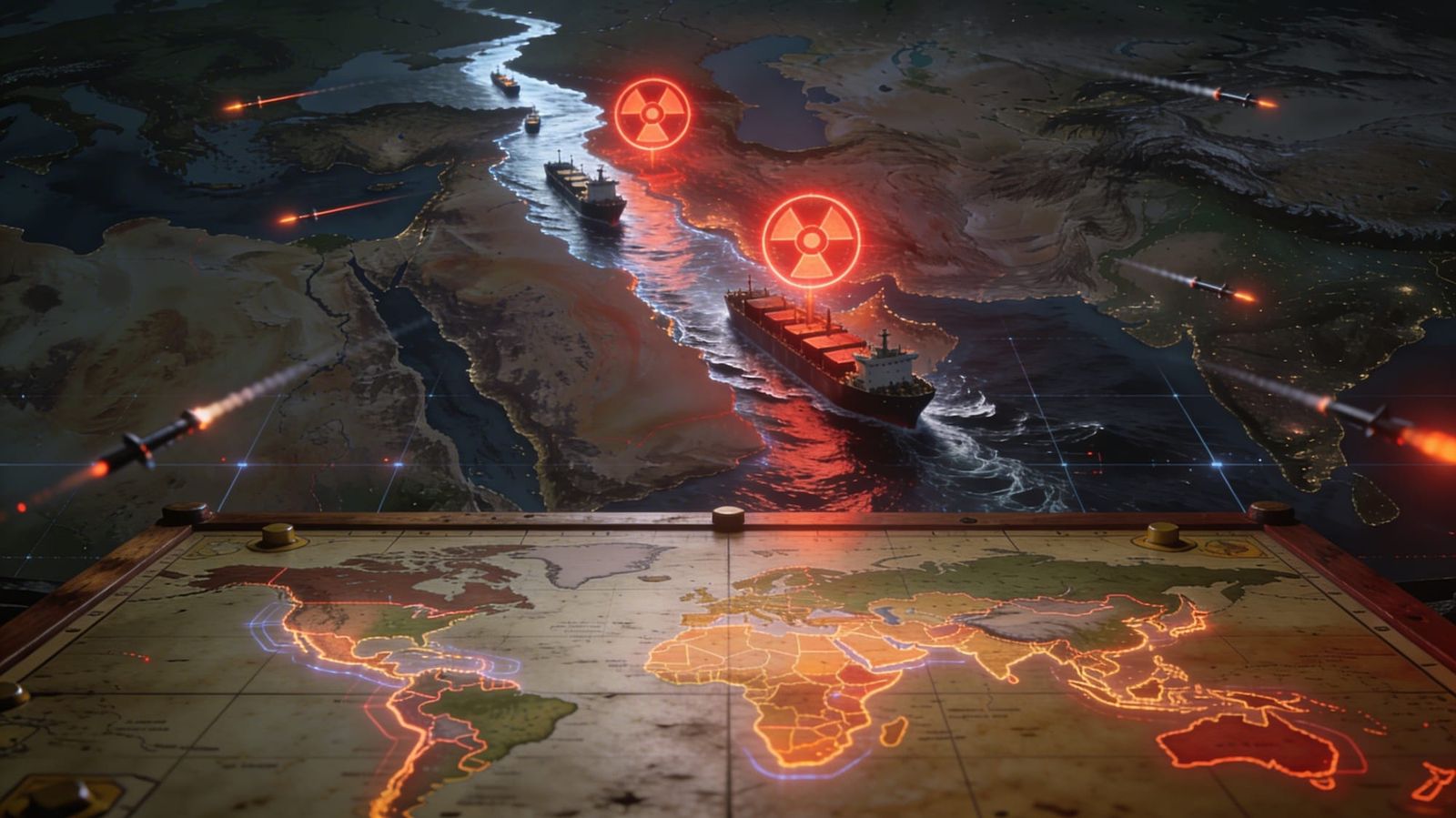
I recently had a conversation with a professional acquaintance. This gentleman has decades in the defense industry and is the kind of man who runs numbers until they hold up in a room full of people trying to break them.
During our conversation, he would shift back and forth between the task at hand and, due to his past work, various geopolitical happenings. It was in one of those sidebars where he began to really focus in on the current conflict in Iran and, more specifically, the Strait of Hormuz.
He has long held that there are two places on earth where nuclear conflict isn't a risk but a near certainty the moment bullets start flying in earnest. The Strait of Hormuz and Taiwan. It was the Strait that held his attention that day. He began to open up about what he called his "morbid concern, or interest" in the events, due to the wargames his teams ran on the Strait during his time in the defense industry. The conclusion wasn't a matter of debate, he claimed. Zero chance of a non-nuclear resolution if the United States ever tried to control that waterway by force.
And his view hasn't moved. With a ceasefire fresh and Iran's mullahs and IRGC still standing, he's convinced America has exactly two options: roll over and leave that regime intact, or walk into a catastrophe involving hundreds of thousands of boots on the ground or a nuclear exchange nobody wins.
A few days before this conversation, in a discussion about the board game Risk, a parallel was drawn, and the question was asked: "Is Trump using the Alaska, Greenland, and Venezuela approach in real life?" The three chokepoints that lock North America and change everything about how you engage the rest of the board. Is this what is being used to bring back the Monroe, or as some have started calling it, the Don-roe, Doctrine in U.S. foreign policy? And if so, how does this play into the assessment given by my acquaintance from the defense industry?
Because if he's right, none of that matters. If the Strait of Hormuz is an automatic nuclear flashpoint the moment the U.S. applies real force, then no amount of strategic repositioning changes the outcome.
I was fascinated by his rigorous stance, backed by decades of field experience. I wanted to press him, challenge the position, dig into the gaps, but the conversation had a purpose, and I wasn't about to hijack it into a foreign policy debate. So I let him talk. And I'm glad I did, because the more he laid it out, the more my own assessment was racing in the opposite direction. There was a broad gap between where he stood and where I stood, and I couldn't stop turning it over. The data, the strategy, the moves already made on the board, they all point somewhere different. Toward a United States that has quietly repositioned itself to win this without catastrophic casualties or a nuclear flashpoint. Not through luck, but through years of bold moves, most people weren't paying attention to or weren't willing to give credence to.
So, What Was in Those Wargames Two Decades Ago?
The public record has Millennium Challenge 2002. $250 million. Two years to design. 13,500 participants. The stated goal was to prove the U.S. could decisively defeat an Iran-modeled adversary in the Persian Gulf. It proved the opposite, and the Pentagon buried the result.
But MC2002 wasn't the only game being run. Defense contractors, the companies actually building the offensive strike packages, the naval defense systems, the missile architecture being modeled in those scenarios, were running their own. Private. Internal. And by my acquaintance's account, arriving at conclusions the Pentagon wasn't eager to publish.
His teams weren't detached observers. They were embedded in the machinery of those simulations. When you build the tools, you understand their limits better than anyone writing doctrine in Washington.
And what those internal wargames kept producing, he stated, was the same answer every time. There were only two places on earth where conflict reliably ended in nuclear exchange: the Strait of Hormuz and the Strait of Taiwan. These two bodies of water were a perfect combination that could lead to global trade disruption and volatile, uncontainable alliance structures. Even before BRICS formalized the axis of opposition, the alignment of interests around both straits was clear enough. A serious military engagement at either chokepoint would trigger responses from nuclear powers, even if they were not primary actors upfront.
The escalation ladder he described was sequential and, in his telling, nearly unavoidable. If the U.S. were to consider a move on the Strait, or Iran for that matter, significant numbers of boots would be needed on the ground. Likely a total number that is a multiple of the entire Global War on Terror commitment, just to have a credible shot at taking and holding the Strait. With that kind of mass comes the death toll to match. The American public and its allies would be forced to absorb losses at a scale not seen since the World Wars. The political, human, and economic weight would be what breaks the containment ceiling, leading to escalation and reinforcement responses from larger allied nations to Iran, like Russia and China. The spiral from there was easy to see. Tactical nukes first, theater-level strikes still dressed up in the language of containment. Then, full-scale warfare as the alliance triggers pulls in the powers who were never going to sit out a conflict of that magnitude. Then city busters. Strategic nuclear exchange. The kind that doesn't have a phase four.
Van Riper, who led the opposing force in MC2002, said nothing was learned after the Pentagon reset the exercise and walked away with a scripted victory. My acquaintance would agree, not because the public exercise was flawed, but because the private ones were telling the same story and nobody wanted to carry that answer publicly. Maybe it could even explain some of the actual U.S. foreign policy decisions of the time, the hesitations, the half-measures, the lines drawn and never enforced. If your own wargames tell you the only exit from a Hormuz conflict is a city buster, you find other ways to manage the problem. But that was 2005. The question worth asking now is whether any of that is still true. And there is one more question the wargames never thought to ask: what does the threat picture look like if you don't act, and Iran gets the bomb?
Twenty Years of Data in a World That Moves in Months
Those models of the early 2000s were essentially based on three large assumptions.
(1) A strong, intact Iranian military. (2) A U.S. so dependent on Persian Gulf oil that losing the strait was existential. (3) Great powers with both the motive and the margin to step in militarily.
All three are gone. And that raises a question worth sitting with: how long does wargame data actually hold?
In 2002, it might have taken a significant amount of time to meaningfully shift the battlefield calculus. New weapons systems, new intelligence infrastructure, new doctrinal development all of these things moved on procurement and policy timelines. The conclusions from one decade's simulation had a reasonable shelf life into the next.
That's not the world we're in anymore. The pace of technology development, intelligence capability, and weapons systems integration has compressed what used to take years into months. What took five years in 2002 can happen in five months today, or less. The gap between a wargame's assumptions and battlefield reality used to be measured in administrations. Now it can close inside a single conflict.
Iran's military is the proof. Since Operation Epic Fury opened, U.S. forces destroyed or incapacitated more than 120 Iranian naval vessels, striking major facilities at Bandar Abbas, Chabahar, and Konarak within the first hours using Tomahawk cruise missiles from naval destroyers. By the ceasefire, more than 85 percent of Iran's defense industrial base was destroyed along with the majority of its ballistic missiles, launcher vehicles, and long-range attack drones. Missile production reduced to zero. Command and control were shattered by more than 2,000 strikes. Leadership losses, paralysis, desertions across the force, and a current leader who is either dead or nearly dead while the regime pretends he is live posting on X.
The old theory needs a thinking, adaptive, intact enemy. The current Iranian leadership is anything but. When Iran launched over 300 drones and missiles at Israel in April 2024, 99 percent were intercepted. The pattern held in October 2024 and the Twelve-Day War of June 2025. Every real-world test confirmed it: Iran could never execute the Van Riper playbook.
The swarm that sank sixteen ships in a 2002 simulation never showed up in reality. Not for lack of wanting. The coordination, command infrastructure, and platforms required had been taken apart piece by piece, not over decades, but through an accelerating cycle of targeted degradation that the old wargame timeline never could have modeled. By the time this conflict formally started, the Iranian opponent those simulations were built around no longer exists.
As for the second assumption, U.S. dependence on Persian Gulf oil, the shale revolution alone dismantled it. And the Alaska, Venezuela, Greenland Risk strategy is amplifying that further. Alaska production ramped. Venezuelan heavy crude is flowing again with U.S. control. Western Hemisphere supply chains that bypass the strait entirely carry none of the war-risk insurance premiums and answer to no chokepoint Iran controls. When the Strait went dark in late February, America absorbed it without a domestic energy collapse. That's a structural shift two decades in the making and one we don't give enough credit to.
The third assumption was that Russia and China would step in militarily, but this runs into the same problem. They are providing Iran with intelligence analysis, AI-enabled analytics, commercial satellite imagery, weapons, and military equipment, enabling at arm's length with plausible deniability. They fundamentally understand that the rules of the game have changed. A direct confrontation with a United States that controls its own energy future, has degraded the Iranian military to a fraction of its former capability, and holds the Western Hemisphere board is a much different cost calculation than in prior decades.
Data has a shelf life. In a world moving this fast, that shelf life is shorter than most people, including the people who generated the data, want to admit.
The Variables the Wargames Couldn't Model
Now, there are variables the wargames likely never even considered as possibilities.
Their models assumed the United States needed, and would continue to need, the Strait badly enough to absorb catastrophic escalatory risk to keep it open. That desperation is where nuclear thresholds live, and with it removed, you change the calculus on everything. But energy dependence is only the first variable. The wargames also never modeled what a nuclear-armed Iran would mean for the very threat picture they were trying to solve, and they never anticipated the regional alignment shift that has quietly surrounded and isolated Iran in ways that would have been unthinkable in 2002. Three variables. All unmodeled. All material to determine whether the earlier conclusion still holds.
Start with the first. Enter the Risk strategy, which has been playing through my mind non-stop since it was brought up in jest a few days ago. I think the jest may have actually been an accidental pattern recognition, a framing for how the calculus changed overall with the current administration.
In the game Risk, North America is the second most valuable continent to control. Three external entry points: Alaska, Greenland, Venezuela. Lock those three, and you've built an impregnable base with few borders to defend. You move to the rest of the board in a large position of strength due to the resources, and the same is true in real-world geopolitics and foreign policy. It is a key position in the Monroe Doctrine overall.
That's what's been happening in real geopolitics.
Alaska: oil production ramped, critical minerals development, Arctic military posture.
Venezuela: the world's largest oil reserves now under reconstruction and U.S. control after the U.S. removed Maduro, heavy crude flowing to Gulf Coast refineries already built for it.
Greenland: Arctic flank security, rare earth minerals, northern chokepoint against Russian and Chinese encroachment.
What does that mean for the Hormuz? The United States is now the world's largest oil producer. Western Hemisphere supply chains bypass the strait entirely. Little to no war-risk insurance premiums, no long-haul freight exposure. When the Strait went dark in late February, America absorbed it without a domestic energy collapse. That meant measured, targeted pressure instead of a panicked ground campaign driven by economic desperation.
His nuclear conclusion was right for a country with no other options. We have other options now, and they were built before the fight arrived. The next two variables explain why the alternative he prefers, rolling over and leaving the IRGC intact, was never actually the safe path either.
Rolling Over Was Never the Safe Option
My acquaintance and the previous foreign policy positions of the U.S. appear to frame the choice with Iran as a catastrophe that led to capitulation. What the wargames never stress-tested was the catastrophe on the other side of capitulation.
Consider what a nuclear Iran actually means. Not Iran as the conventional regional irritant the 2002 simulations modeled, but Iran with a deliverable nuclear weapon, still the world's leading state sponsor of terror, still run by a regime that has never demonstrated the rational deterrence calculus that kept the Cold War from going hot. A nuclear Iran doesn't just raise the regional threat level. It hands China and Russia a forward-deployed nuclear proxy that has, by any honest assessment, never shown much interest in restraint. That doesn't reduce the number of likely nuclear conflicts. It multiplies them. Every IRGC miscalculation, every proxy action, every piece of regional adventurism now carries a nuclear return address. The wargames worried about a U.S.-China or U.S.-Russian nuclear exchange. They never modeled what it looks like when Beijing and Moscow have a nuclear-armed, terror-sponsoring client with a forty-year record of saying exactly what it intends to do with nuclear weapons. Rolling over and leaving that regime intact isn't the safe option. It's a different kind of catastrophe on a longer fuse.
The third variable the wargames missed is the regional alignment that has quietly flipped underneath this conflict. The Abraham Accords weren't just a diplomatic footnote. They were the first visible crack in the assumption that Arab states would either oppose or stay neutral in any serious U.S.-Israel confrontation with Iran. What has followed since is something that would have been genuinely unthinkable to the wargame architects of 2002. Saudi Arabia is in open strategic cooperation with the United States and Israel. Arab neighbors siding with the coalition over Iran. A regional architecture increasingly organized around boxing in Tehran rather than accommodating it. The ceasefire that took effect on April 8 didn't happen in a vacuum. It happened in a region where Iran's traditional buffer of regional sympathy has largely evaporated.
This matters directly for the Russia and China calculation. Their willingness to step in militarily, already eroded by U.S. energy independence and Iran's degraded military capacity, gets further constrained when the surrounding region isn't offering them a friendly operating environment. You can't project power into a theater where the neighbors have chosen the other side. The old models assumed a relatively neutral Arab world that could be leveraged, or at a minimum wouldn't actively work against Iranian interests. That assumption is gone, and it takes another layer of the escalation ladder with it, the one that previous models believed was unavoidable.
What remains of the nuclear risk today is miscalculation, not design. Degraded Iranian command and control. Hardline new leadership with nothing to lose politically. Proxy forces that answer to nobody cleanly. A lucky hit on a significant U.S. asset. A chain of accidents in a confined theater where communication channels are broken, and Tehran's new leadership is still calculating what leverage it actually has left. That's the scenario worth watching, not a deliberate great-power decision to go nuclear over a weakened, regionally isolated Iran.
The hemisphere position buys time against the worst of it. More non-Hormuz oil flowing means less domestic pressure to take maximalist risks in a fragile ceasefire environment. A locked home base means you can afford patience instead of gambling everything on the desperate ground campaign. It seems considerations like these hadn't been uploaded into my acquaintance's current data set.
The Lens You Look Through
I want to be clear about something before closing this out. The gentleman I spoke with is not wrong to have held this position. His record, his access, his decades inside the machinery of American defense, these aren't credentials you dismiss. He has likely sat in rooms and seen documents that would change the perspective of most people writing about this conflict from the outside. That carries weight.
But here is what I kept coming back to. The lens you develop over a career becomes the lens you look through by default. When you have spent decades running scenarios where Hormuz ends in nuclear warfare, when that conclusion has been validated internally across multiple exercises and never seriously challenged by the public record, it becomes less of a conclusion and more of a fixed point. You stop questioning whether the assumptions underneath it still hold because the conclusion has felt true for so long.
That isn't a criticism of the gentleman in any way, shape, or form. It's simply a description of how expertise works. The same depth of knowledge that gives you insight also gives you blind spots. The inside-the-beltway view is sharper on certain things than almost any outside perspective can be, but it can also calcify around the data sets that formed it. The world that produced those wargames was real. The conclusions were earned and valid. The problem is that the world has moved and the data didn't get updated.
The shale revolution wasn't in those models. The Abraham Accords weren't in those models. The fifteen-year degradation of Iranian military capacity through layered pressure, cyber, sanctions, and strikes wasn't in those models. A U.S. intervention in Venezuela that locked the western hemisphere board wasn't even a consideration. These aren't small variables. They are the kind of structural shifts that change what a conflict at the Hormuz actually costs, who absorbs that cost, and whether the escalation ladder his teams mapped still has the same rungs in the same order.
You can't see that from inside a framework built before those shifts happened. You have to be willing to take off the glasses, step back from the model, and ask whether the inputs still match the world outside the room. That's not something that comes naturally when your inputs have been validated by decades of experience and institutional access. It takes a particular kind of intellectual curiosity to look at a conclusion you have held and ask whether the ground beneath it has moved.
I started in the Ron Paul wing of foreign policy. Blowback theory. Skepticism of every argument for American military action. I carried that lens for years and it shaped how I read every foreign policy decision the U.S. made. It took evidence piling up that didn't fit the model before I was willing to update it. I understand the pull of a framework that has felt true for a long time.
But the math has changed. The board has moved. The pieces are in different positions. And a strategy built on locking the western hemisphere, degrading the adversary over decades, flipping regional alliances, and removing energy dependence before the conflict arrived has produced a different set of options than the ones his models ever had to account for.
Old maps don't win new wars. And the most dangerous thing isn't the enemy on the board. It's being too certain of a map drawn in a different era and using that certainty to blackpill our future and American prowess.
Sources
- Millennium Challenge 2002 — Wikipedia
- MC2002: The Simulation That Predicts Hormuz Conflict — National World
- A $250 Million War Game and Its Shocking Outcome — Mackenzie Institute
- That Time a Marine General Led a Fictional Iran Against the U.S. Military — We Are the Mighty
- 2002 Exercise Showed How Swarm of Small Craft Could Overwhelm U.S. Ships — Press Democrat
- Learning Curve: Iranian Asymmetrical Warfare and MC2002 — CIMSEC
- America Lost an Infamous Wargame to Iran. That's Why We're Winning Now — Daily Wire
- Operation Epic Fury and the Collapse of Iran's Layered Naval Defense — Gulf International Forum
- Peace Through Strength: Operation Epic Fury — White House
- Operations Epic Fury and Roaring Lion: 3/16/26 Update — JINSA
- Operations Epic Fury and Roaring Lion: 4/6/26 Update — JINSA
- Operation Epic Fury Update — April 7, 2026 — SOF News
- The Iran Strikes, Explained — AJC
- 2026 Strait of Hormuz Crisis — Wikipedia
- 2026 Iran War — Wikipedia
Disclosure: The ideas, arguments, and conclusions in this piece are the author’s own. AI was used for research, fact-checking, editing, and production under the AI Use Policy.
Get The Sovereignty Ledger by email
Free. One essay at a time. Unsubscribe whenever.
Get the next essay by email
Free. One essay at a time. Unsubscribe whenever.