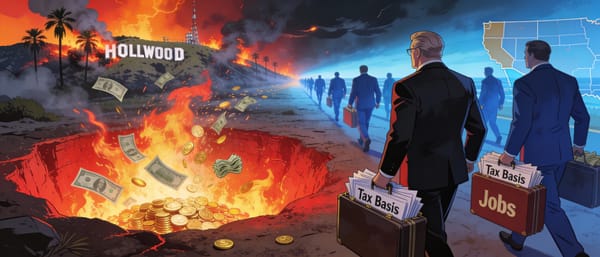
Whose Laffing Now, California? How a Napkin Predicted California's $1T Exodus
A labor union's proposed wealth tax hasn't even made the ballot—but it's already triggered a $1T billionaire exodus from CA. The math shows every remaining household could absorb $576–$1,742/yr in higher taxes and cuts. The Laffer Curve isn't theory. It's happening in real time.

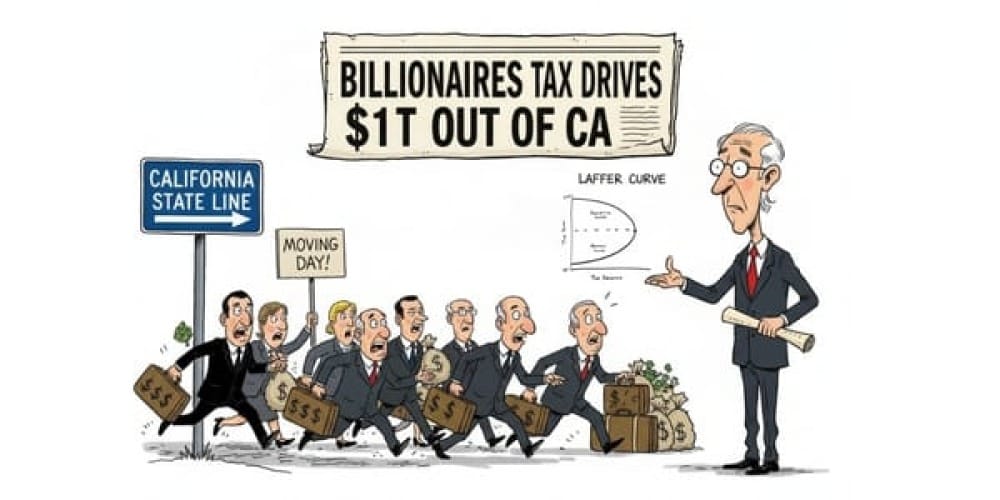
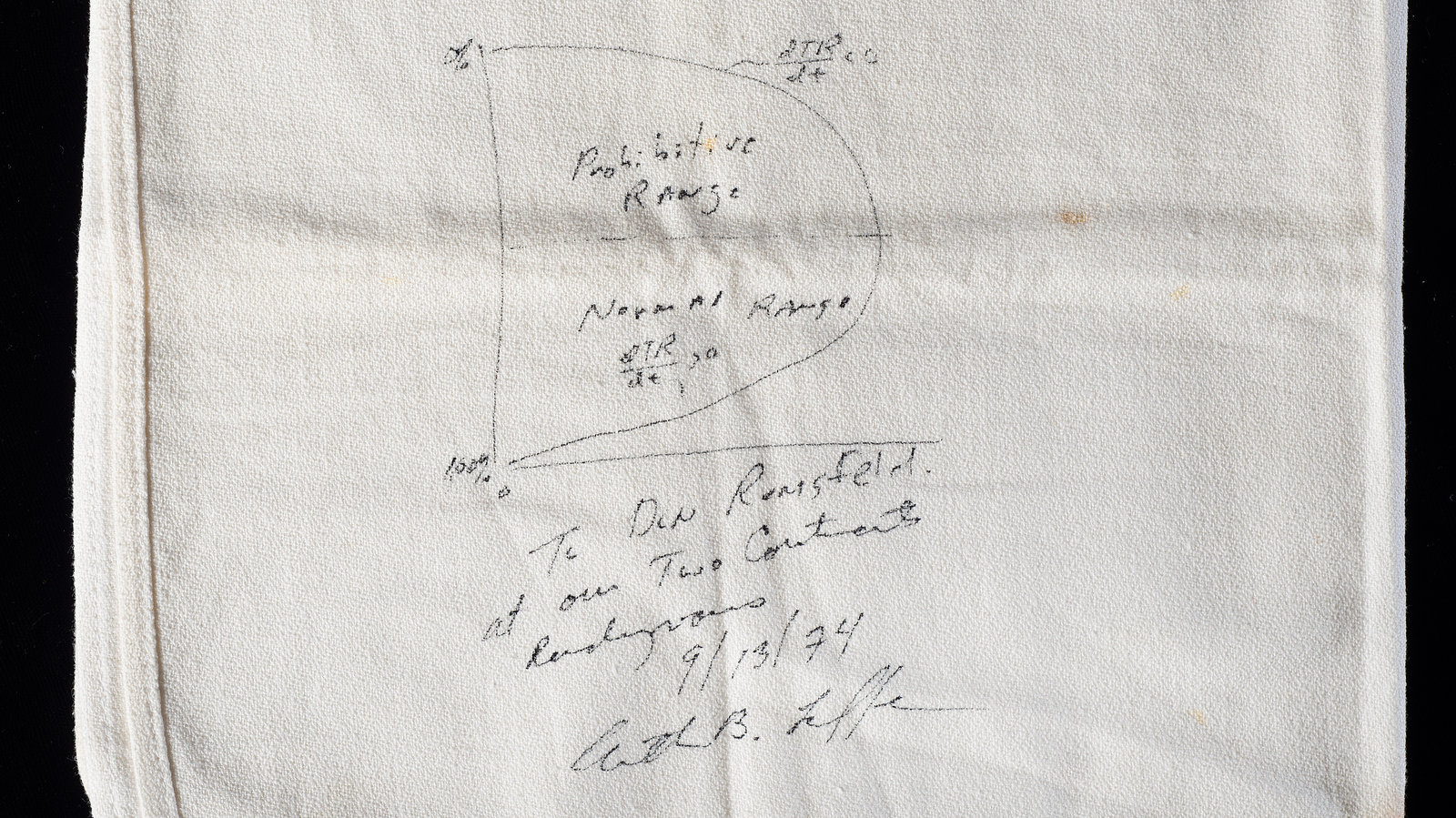
In 1974, economist Arthur Laffer sketched a simple curve on a cocktail napkin for Donald Rumsfeld and Dick Cheney. The idea was elegant: at some point, raising taxes doesn't raise revenue—it destroys it. People change their behavior. They work less, invest elsewhere, or simply leave.
Fifty years later, California is running a live demonstration of that principle—and the results are catastrophic. Not for the billionaires, who have the means to leave. For the 39 million Californians who can't.
A Trillion Dollars Walked Out the Door
Venture capitalist Chamath Palihapitiya dropped a bombshell on X in early January: roughly $1 trillion in billionaire wealth has already fled the Golden State. That's half of California's estimated $2 trillion in billionaire assets—gone before a single ballot was cast.
The trigger? A proposed ballot initiative called the 2026 Billionaire Tax Act, backed by the Service Employees International Union–United Healthcare Workers West (SEIU-UHW). The measure would impose a one-time 5% tax on the net worth of California residents exceeding $1 billion. The union sold it as an emergency measure to offset federal budget cuts to healthcare, education, and food assistance programs.
Before we go any further, it's worth pausing on what just happened here: a labor union—not the governor, not the state legislature, not any elected body with constitutional taxing authority—drafted and filed a tax proposal that would confiscate private wealth to fund programs that directly benefit the union's own members. SEIU-UHW represents over 120,000 healthcare workers. Ninety percent of the revenue from the billionaire tax would be required to be spent on healthcare services, according to the LAO's analysis. This is a private interest group using the ballot initiative process to levy a tax on other citizens for its own benefit—bypassing the legislature entirely because, as tax attorneys have noted, a wealth tax "wouldn't make it through California's often byzantine legislative process, which requires a two-thirds majority to enact tax increases." Even Governor Newsom—hardly a tax skeptic—has staunchly opposed wealth taxes and vowed to fight this one.
The union couldn't get its tax through the democratic process that exists for a reason. So it went around it.
The Retroactive Trap That Backfired
Now here's the detail that turned a bad policy debate into an economic catastrophe: the tax was designed to be retroactive.
The original language of the initiative set an effective residency date of January 1, 2025—a full year before the measure would even reach voters. That would have trapped every billionaire who was a California resident in 2025 under a tax that didn't exist yet and wouldn't be voted on until November 2026. Think about what that means: you'd be taxed under a law that was retroactively applied to a year in which the law hadn't been proposed, debated, or approved. As the Pillsbury Law firm documented, the original draft would have subjected "tax year 2025 California residents to the wealth tax in 2026."
After intense legal scrutiny—Baker Botts warned the retroactive provision likely violated due process under both the U.S. and California Constitutions, particularly since the Supreme Court has indicated heightened scrutiny for "the creation of a wholly new tax"—proponents filed an amendment on November 26, 2025, shifting the tax obligation date to January 1, 2026.
That amendment cracked open an escape hatch—and the wealthiest people in America sprinted through it.
Google co-founder Larry Page—the world's second-richest person—left California over the proposal. His co-founder Sergey Brin shifted business entities out of the state in the ten days before Christmas, terminating or relocating 15 California LLCs overseeing his investments. Peter Thiel headed to Florida. David Sacks announced a new Craft Ventures office in Austin on New Year's Eve. At least a half-dozen billionaires left before the January 1 deadline, with financial advisers warning that more than a dozen others could soon follow.
The irony is devastating. The original January 2025 date was designed to make escape impossible. It was so legally aggressive that it had to be amended. And that amendment is what made escape possible. A union's overreach didn't just fail to trap the billionaires—it gave them a reason and a window to leave.
The tax hasn't even made the ballot yet. It still needs roughly 546,651 valid signatures to qualify for November 2026. And yet the mere proposal has already triggered a wealth exodus of historic proportions.
That's the Laffer Curve in action. Not at the margins. Not in a textbook. In real time, at a scale of one trillion dollars.
The Laffer Curve Isn't Just About Rates—It's About Behavior
The common misunderstanding of the Laffer Curve is that it's only about income tax rates—find the "sweet spot" and you maximize revenue. But the deeper insight is about behavioral response to taxation. People aren't static inputs in a spreadsheet. They make decisions. They move. They restructure. They stop doing the things that generated the taxable activity in the first place.
Treasury Secretary Andrew Mellon understood this a century ago, writing in 1924 that "high rates of taxation do not necessarily mean large revenue to the government." He pushed the top bracket from 73% to 24%, and personal income tax receipts rose from $719 million in 1921 to over $1 billion by 1929. Reagan applied the same logic in the 1980s, cutting the top marginal rate from 70% to 28%.
California's situation is a different flavor of the same principle. The state's top marginal income tax rate is already 14.4% for earners over $1 million—the highest in the nation. Billionaires were already paying that willingly. What they weren't willing to accept was a 5% confiscation of their total net worth on top of it. The behavioral response wasn't to work less; it was to leave entirely.
As Palihapitiya put it: "California billionaires were reliable taxpayers. They were the sheep you could shear forever. Now California will lose this revenue source FOREVER."
The Budget Math Is Where This Gets Real for Everyone Else
To understand why this isn't a story about billionaires—it's a story about every Californian who depends on state services or pays state taxes—you have to understand how California funds itself and how dangerously concentrated that funding model is.
California's personal income tax is the single largest source of General Fund revenue, accounting for approximately 68% of General Fund revenues. The top 1% of earners pay roughly half of all personal income taxes collected in the state—a proportion that has exceeded 40% every year since 2004, according to the California Legislative Analyst's Office. In raw dollars, the top 1% contributes over $122 billion per year in income taxes to California.
Now layer in the state's extraordinary dependence on capital gains. Within the personal income tax, capital gains have averaged roughly 16% of total tax liability over the past decade, spiking to 25% in boom years like 2021. These gains are overwhelmingly concentrated among the wealthiest Californians—the exact people who are now leaving.
California was already staring at a fiscal abyss before the billionaire exodus. The LAO's November 2025 forecast projected an $18 billion deficit for fiscal year 2026-27, with structural deficits ballooning to approximately $35 billion annually by 2027-28. Governor Newsom's January budget painted a rosier picture—a $2.9 billion deficit—but only by assuming the stock market continues to soar and no downturn materializes. The LAO called Newsom's approach "alarming" and warned that failing to account for market risks "would put the state on precarious footing."
Legislative Analyst Gabe Petek put it starkly: the state has run deficits totaling $125 billion over the last four years, and they "have persisted even as the state's economy and revenues have grown, underscoring that the problem is structural rather than cyclical."
This is the fourth consecutive year California has faced a projected deficit. Each time, Sacramento plugged the gap with one-time maneuvers—internal borrowing, reserve drawdowns, enrollment freezes, spending deferrals. Those tools are nearly exhausted.
And into this fiscal crisis, SEIU-UHW introduced a ballot measure that is actively accelerating the departure of the very taxpayers the state depends on to remain solvent.
What This Will Cost You: The Math of Redistribution
The question isn't whether ordinary Californians will pay for this—it's how much. We can model it.
The Revenue Hole
California's top 1% pays approximately 38-45% of all state income tax revenue, which totals around $317 billion annually. Using conservative estimates, the top 1% contributes roughly $127 billion per year. If even 10-30% of top earners migrate—a range consistent with what we're already seeing—the annual revenue loss lands between $12.7 billion and $38 billion. For context, the Manhattan Institute's study of New York found that just a 3% departure of high earners cost New York City $576 million annually.
Where the Burden Lands
That lost revenue has to go somewhere. The state has three levers: cut services, raise taxes on remaining residents, or deficit-spend. If California maintains most services (cutting roughly 20%) and limits deficit spending to another 20%, that leaves 60% of the gap to be filled by tax increases on everyone else.
Running those numbers: 60% of a $12.7-$38 billion revenue loss yields $7.6 billion to $23 billion in new tax burden. Spread across approximately 13.2 million California households outside the top 1%, that's $576 to $1,742 per household per year in additional costs—through some combination of higher taxes, new fees, and reduced services.
For a median California household earning $84,097, that represents an effective cost-of-living increase of 0.7% to 2.1%.
The Number Is Actually Worse
That model significantly underestimates the real impact because it only captures lost income tax revenue. It excludes sales tax losses from reduced high-earner spending, corporate tax losses from business relocations, property tax erosion, and the productivity drag from degraded public services. Applying even a conservative 1.5x multiplier for these cascading secondary effects pushes the effective cost-of-living increase to 1-3% annually—compounding each year the exodus continues.
California already has a cost of living roughly 40% above the national average. If this trajectory holds over five years, the state's cost-of-living premium could climb from 40% to 45-55% above the national average. For a state where the median household already spends $86,408 per year and the average home costs $793,150, those percentages translate to thousands of real dollars out of family budgets.
Sacramento's Playbook: Every Option Hurts Working Families
The specific mechanisms for filling the gap are already becoming visible—and none of them spare the middle class.
Service cuts are underway. The Newsom administration expects roughly 522,000 Californians to lose Medi-Cal coverage in 2026-27, rising to 1.8 million in future years. The state has already frozen new Medi-Cal enrollment for undocumented adults, eliminated dental coverage for some populations, reinstated asset limits for seniors and people with disabilities, and proposed $30 monthly premiums for certain populations—on a program that has never charged premiums. The $222.4 billion Medi-Cal program covers over 14 million Californians—more than one-third of the state's population.
New taxes are next. Progressive Democrats are already "floating a separate corporate tax" to backfill the shortfall. The Senate Revenue and Taxation Committee chair has called for "a statewide discussion about how to even out this volatility." CalMatters noted California could potentially reinstate an estate tax—eliminated in 2005—generating an estimated $3.6 billion annually. But $3.6 billion barely dents a $35 billion structural deficit. The most frequently discussed option is extending the sales tax to services—everything from doctor visits to haircuts to accounting—which a previous blue-ribbon commission estimated could generate $10 billion annually. That's a direct cost-of-living increase on every working family for every service they use.
The debt load is already crushing. California has $800 billion in long-term obligations—the largest total of any state—and $20,300 in long-term debt per resident. The state's reserves, which Newsom promised not to touch just three years ago, have been steadily drained to cover chronic deficits even without a recession. The LAO has explicitly warned the stock market appears "overheated" and at "high risk of reversing course"—a downturn that would crater income tax revenues on top of the losses from the exodus.
As Adam Michel, director of tax policy studies at the Cato Institute, told Fox News: the proposal is "both diagnosing the problem incorrectly and also won't fix the problem that is being diagnosed."
Europe Tried This. It Failed. And They're Making It Worse.
California isn't pioneering anything here. According to an OECD study, most European countries that implemented wealth taxes eventually repealed them: Austria in 1994, Denmark and Germany in 1997, the Netherlands in 2001, Finland, Iceland and Luxembourg in 2006, Sweden in 2007, and France in 2018. The pattern was consistent: less revenue than promised, heavy administrative costs, and capital flight.
And they haven't learned. On February 12, 2026, the Dutch House of Representatives passed a 36% tax on unrealized capital gains—paper gains on assets you haven't sold—set to take effect January 1, 2028. A survey by the Dutch Association of Tax Advisors found that none of 12 surveyed countries has a comparable tax. Even the lawmakers who voted for it admitted the plan was "still flawed" but said they supported it only because delay was costing the treasury €2.3 billion per year.
Dutch Parliament member Michiel Hoogeveen of the conservative JA21 party laid out exactly how this destroys wealth in a simple example every American should understand: You own 500 shares worth €50,000 on January 1. By the next January 1, they've risen to €100,000. You haven't sold anything. But you now owe 36% on the €46,400 paper gain (after a small exemption)—a €16,704 tax bill due in May. Now suppose by May the shares have fallen back to €60,000. The tax bill doesn't change—it was calculated on the January 1 peak. To pay €16,704, you're forced to sell 140 of your 500 shares—28% of your holdings, gone permanently. Your real gain was only €10,000. But you paid €16,704 in taxes. You turned a €10,000 gain into a €6,704 net loss. The government taxed wealth that didn't actually exist in any realized form and left you worse off than when you started.
This is where California is headed. The 2026 Billionaire Tax Act is a one-time 5% wealth confiscation—but as Palihapitiya noted, "one-time tax… right." Once the mechanism exists, the rate changes. The target threshold drops. The "emergency" becomes permanent. The Netherlands abandoned its original wealth tax in 2001, and now it's back with something even more aggressive. The ratchet only turns one direction. And the same unrealized-gains logic the Dutch just codified has already been floated at the federal level in the United States.
The Real Lesson
The SEIU-UHW wanted $100 billion to plug holes in healthcare, education, and food assistance. What they've gotten instead is a trillion-dollar exodus that will make every one of those budget problems worse—and every Californian poorer in the process.
The math is unforgiving. At the low end of estimates, every California household outside the top 1% absorbs an additional $576 per year in some combination of higher taxes, new fees, and degraded services. At the high end, it's $1,742—and that's before the cascading secondary effects are priced in. Over five years, a state that is already unaffordable for millions of its residents becomes dramatically more so.
This is not a complicated economic puzzle. It's the Laffer Curve drawn on a napkin, playing out in real time across the most populous state in the union. Tax something and you get less of it. Tax it aggressively enough and it disappears entirely.
The billionaires are gone. Their income tax revenue is gone. Their capital gains are gone. Their spending, their investments, their employees' tax contributions—gone. And a labor union that has no taxing authority, represents a private interest, and couldn't get a single legislator to carry its proposal through the democratic process is the entity that lit the match.
Even Governor Newsom—told the New York Times he would "do what I have to do to protect the state" from the ballot measure. When your own Democratic governor is fighting your tax proposal because it's destroying the state's fiscal foundation, that's not a partisan debate. That's math.
Arthur Laffer was right. Andrew Mellon was right. And unless this ballot initiative is pulled, California is about to prove it in the most painful way possible—on the backs of the middle-class families who can't afford to leave.
Sources
- Fox Business, "California billionaire tax proposal hemorrhages $1 trillion as billionaires flee" (January 2026)
- CBN News, "California Loses $1 Trillion as Billionaires Flee from Looming Wealth Tax" (January 2026)
- California Policy Center, "The Union that May Have Broken California" (January 2026)
- Bloomberg, "California Wealth Tax Threat Pushes Billionaires to Texas, Florida" (January 2026)
- Yahoo Finance / Moneywise, "Billionaire Exodus Sees $1T in Wealth Exit California" (January 2026)
- Newsweek, "California Wealth Tax: What Billionaires Have Said About Leaving State" (January 2026)
- Fox Business, "California's 'billionaire tax' will be 'disastrous'" (February 2026)
- Reason Foundation, "Why Billionaire Tax Would Backfire and Haunt California" (January 2026)
- California Globe, "Bye Bye Billionaires: Gavin Newsom's California Exodus" (January 2026)
- CNBC, "California's controversial wealth tax proposal leaves billionaires with little way out" (January 2026)
- Baker Botts, "California 2026 Billionaire Tax Act" (December 2025)
- Pillsbury Law / SeeSALT, "California's Amended Wealth Tax Initiative Meets Five New Foes" (December 2025)
- California Residency Tax Planning, "California's Billionaire Tax Act: The Challenge of Changing Residency on Short Notice" (January 2026)
- Inside SALT / Pillsbury, "Biting the Hand That Feeds: California Faces New Proposed Wealth Tax" (November 2025)
- Ballotpedia, "California One-Time Wealth Tax for State-Funded Health Care Programs Initiative (2026)"
- CBS News, "California could impose a billionaire tax. Here's how it would work" (January 2026)
- California Legislative Analyst's Office, "The 2026-27 Budget: California's Fiscal Outlook" (November 2025)
- California Legislative Analyst's Office, "The 2026-27 Budget: Overview of the Governor's Budget" (January 2026)
- California LAO, "Top 1 Percent Pays Half of State Income Taxes"
- California LAO, "Considering Medi-Cal in the Midst of a Changing Fiscal and Policy Landscape"
- CalMatters, "2024 California Budget Whiplash Caused by Volatile Taxes" (June 2024)
- CalMatters, "Big Deficits Loom for California" (November 2025)
- CalMatters, "Reliance on Income Taxes Threatens California Budget" (January 2026)
- CalMatters, "Newsom is set to unveil his last budget. An $18 billion deficit looms" (January 2026)
- CalMatters, "Health advocates to Newsom: Find new money or let millions lose Medi-Cal coverage" (January 2026)
- CalMatters, "Billionaires aren't going to flee California. Others will without a budget fix" (February 2026)
- CapRadio, "California Faces a Bleak Budget Year" (January 2026)
- KCRA, "California's Legislative Analyst Says Governor's Budget Could Leave State in 'Alarming' Situation" (January 2026)
- California Budget Challenge / Next 10, "CA vs. Other States"
- SmartAsset, "What the Top 1% Pays in Taxes Across the U.S. – 2025 Study" (November 2025)
- California Chamber of Commerce, "Income Taxes" (April 2025)
- California Governor's Budget 2025-26, "Revenue Estimates"
- Cal Budget Center, "How Federal Funding Cuts Threaten the Health of Californians" (September 2025)
- Cal Budget Center, "H.R. 1 and the Federal Budget: How California Leaders Can Respond" (July 2025)
- NerdWallet, "California Income Tax: Rates and Brackets 2025-2026"
- Perret, Sarah, "Why Were Most Wealth Taxes Abandoned and Is This Time Different?" Fiscal Studies (2021)
- Trabandt & Uhlig, "The Laffer Curve Revisited," Journal of Monetary Economics (2011)
- Wikipedia, "Laffer Curve"
- Bitcoin News / X, "Dutch Parliament Member Michiel Hoogeveen explains 36% unrealized capital gains tax" (February 12, 2026)
- Bitcoin News / X, "Netherlands House Passes 36% Tax on Unrealized Gains" (February 12, 2026)
- NL Times, "Netherlands likely to start taxing capital gains annually by 2028" (January 2026)
- CryptoNews, "Netherlands risks capital flight with unrealized gains tax" (January 2026)
- Meijburg & Co, "Final bill on Actual Return on Investment in Box 3 Act published" (May 2025)
- Dutch House of Representatives, Michiel Hoogeveen profile