The Isolationist Case Against American Superpower Ignores Two Realities: The Enemy's Own Words and the Vacuum We'd Leave
The blowback theory assumed the enemy was reacting to what we did. It never asked what happens when they're acting on what they believe — and have been telling us so for 45 years.

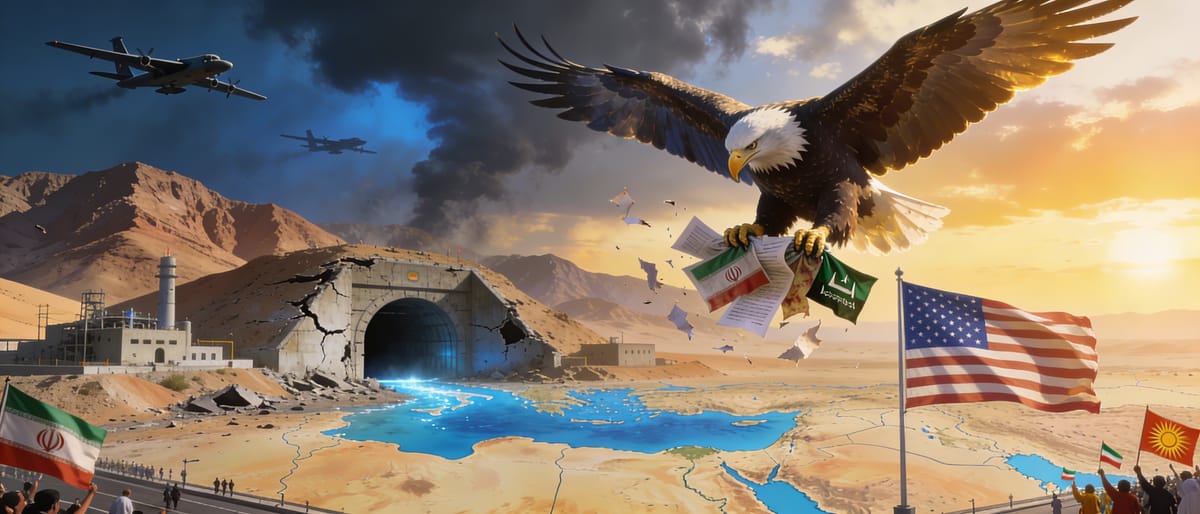
How blowback theory, misplaced empathy, and 45 years of proxy war brought us to Operation Epic Fury.
I have never had a complicated relationship with Uncle Sam. My country, THE USA.
I love this country with the uncomplicated clarity of someone who looks at history and understands the alternatives. No nation in human history has wielded the kind of power the United States holds and shown more restraint with it, more charity through it, or more genuine concern for human rights beyond its own borders. That's not nationalism — it's an honest accounting. Remove the United States from the last century of history and the world that remains isn't more peaceful. It's darker in ways most Americans comfortable enough to critique their own country have never had to seriously imagine.
My skepticism was never about America. It was about the machine that directs American power — and whether the justifications given to the public bore any resemblance to the objectives actually being pursued.
Ron Paul put language to something a lot of us felt but couldn't fully articulate. When he argued from the House floor that intervention creates blowback, that meddling in foreign governments produces enemies, that the American people were being sold wars built on premises that wouldn't survive honest scrutiny — that wasn't anti-Americanism. That was a man who had actually read the foreign policy record and refused to pretend it said something it didn't. Iraq didn't have weapons of mass destruction. The Gulf of Tonkin incident was manufactured. The CIA's fingerprints on foreign governments from Iran in 1953 to Central America in the 1980s weren't conspiracy theory — they were documented history that the foreign policy establishment preferred to leave unexamined.
So when the blowback argument came, I found it compelling. Not because I thought America deserved what happened on September 11th, It unequivocally did not. But because the logic seemed a rational human response: that our actions in the world produce reactions, that people who live under the consequences of American foreign policy develop grievances, and that some fraction of those grievances eventually become violence directed back at us. The honest response to that argument isn't to dismiss it. It's to examine it, not just with empathy, but with an honest attempt to understand incentives.
What I eventually found wasn't that the argument was dishonest. It was that it was incomplete in a way that made it functionally wrong. Not because the historical record changed. The CIA did help overthrow Mosaddegh in 1953. We did arm the Mujahideen. The weapons of mass destruction in Iraq were a fiction dressed up as intelligence. The machine that directs American power has lied before, spent American lives on objectives the public was never honestly told about, and created consequences that outlasted every administration that caused them. I didn't abandon that skepticism. I still carry it. But the blowback framework assumes a specific kind of enemy — one motivated by grievance, capable of satisfaction, interested in resolution. An enemy who, if you remove the provocation, removes the threat.
It never seriously asked what happens when the enemy isn't reacting to what you did. Even if they claim they do.
What happens when they're acting on what they believe, and they've continuously told you so...
Who They Say They Are
Here is the conversation the West refuses to have loudly enough for fear of social or political pushback.
Not because the information isn't available. Not because the voices don't exist. But because the conclusion those voices lead to is uncomfortable enough that it's easier to dismiss the messenger than engage the message. So we call them provocateurs. We call them Islamophobic. We change the subject to legitimate grievances and historical context and the complexity of geopolitics — anything to avoid sitting with what is being said, plainly, repeatedly, by people who lived inside the machine they're describing.
Mosab Hassan Yousef didn't read about Hamas from the outside. His father, Sheikh Hassan Yousef, was one of its founders. He was raised inside its ideology, its strategy, and its theology. When he eventually broke from it — at enormous personal risk — he didn't do so quietly. He wrote it down. He said it out loud. He has repeated it in every forum willing to hear it. The West has largely responded by changing the subject.
Here is what he said. Not what someone said about Hamas. What a man formed inside it concluded about its actual purpose:
"Hamas, on the other hand, Islamized the Palestinian problem, making it a religious problem. And this problem could be resolved only with a religious solution, which meant that it could never be resolved — because we believed that the land belonged to Allah. Period. End of discussion. Thus for Hamas, the ultimate problem was not Israel's policies. It was the nation-state Israel's very existence." — Mosab Hassan Yousef, Son of Hamas
Read that again. The conflict is not about borders. Not about settlements. Not about the specific policies of any Israeli government. The land belongs to Allah. That is not a negotiating position. It is a theological conclusion — and theological conclusions don't have diplomatic solutions.
In a conversation with academic and author Gad Saad, Yousef was equally direct about the broader mission beyond Israel:
Jihad is obligatory on every Muslim. Islam is against all non-Muslims — the priority is just technical. The first mission is to establish an Islamic state on the destruction of Israel. The second mission is to enlarge the Islamic state on the destruction of Western civilization.
Not American foreign policy. Not Israeli settlements. Western civilization.
Mosab Hassan Yousef, Son of the founder of Hamas:
— Eyal Yakoby (@EYakoby) February 26, 2025
"If Israel fails in Gaza, all of us will be next."
Listen to him, he would know. pic.twitter.com/9DVKDOIwo4
You are on that list. Whether you marched against the Iraq War or cheered it. Whether you've spent your life advocating for Palestinian rights or never followed the conflict once. The distinction the Western progressive mind insists on drawing — between political grievance and religious mission — exists in our framework. It does not exist in theirs. They make no distinction between the keffiyeh and the MAGA hat. Both are useful idiots until they are obstacles. There is no version of your identity that removes you from the mission.
Ayaan Hirsi Ali has spent decades trying to explain this at considerable personal cost. She didn't theorize it from a university. She lived it — raised devout in Somalia, shaped by the Muslim Brotherhood as a teenager in Kenya, and eventually honest enough with herself to name what she had been part of. What she has said about Western appeasement is not political commentary. It is testimony from someone who understands both sides of the exchange:
"Every accommodation of Muslim demands leads to a sense of euphoria and a conviction that Allah is on their side. They see every act of appeasement as an invitation to make fresh demands."
And more precisely:
"The more we oblige, the more we self-censor, the more we appease, the bolder the enemy gets."
Ayaan Hirsi Ali warns: nearly 25 years after 9/11, the threat of radical political Islam has evolved. Military victories removed groups like Al-Qaeda and ISIS, but the ideological side—the Dawa—continues to spread. Are Western leaders still blind to this danger?
— Ayaan Hirsi Ali Foundation (@AHAFoundation) December 16, 2025
Clip from… pic.twitter.com/GJfPUm00ax
The West's response has been to give her a security detail and ignore her argument.
Then there is Mohammad Tawhidi — the Imam of Peace — whose biography may be the most instructive of all for this specific moment. Born in Qom, Iran, the heart of Shia Islamic scholarship and the ideological birthplace of the Iranian Revolutionary Guard Corps, Tawhidi went back as a young man to complete his religious studies. What he found there didn't produce a moderate. By his own account, he became completely radicalized, willing to kill anyone who spoke a single word against Ali Khamenei, whom he saw as the link between himself and God. He eventually broke from that ideology — at real personal cost, with his home vandalized and his life threatened — and has spent years since trying to tell the West exactly what he saw from the inside.
The West has largely treated him the same way it treats all of them: with polite applause and continued ignorance of the actual argument.
Here is what Tawhidi has said, directly and without qualification:
"If Christians don't wake up, if Christian leaders don't wake up, then we Muslims who fled from extremists can't help you anymore. We tried warning you."
And on whether this is the enemy's growing strength or the West's failure:
"The question is, did the extremists become stronger, or did the West become weaker? I say it is both."
Did you know… Extremist groups can’t hold bank accounts in UAE, Oman, Qatar etc…
— AustraliaFirstOnly (@gigabasedd) December 19, 2024
But they CAN, in USA, UK, Australia…
Did the Extremists become stronger… or did The Western World become weaker….?
~Imam Tawhidi pic.twitter.com/r1dY38R7cd
Three people. Three completely different countries of origin. Three different sects and traditions within Islam. All arriving at the same conclusion from the inside: the mission is real, the ideology is non-negotiable, and the West's response has been to confuse tolerance with surrender.
Bernard Lewis, Princeton's preeminent historian of the Islamic world, identified the same civilizational dynamic from five decades of academic study. In The Crisis of Islam he wrote that radical elements within the movement view the West as their "ultimate enemy and as the source of all evil" — and that any temporary accommodation is sought only "in order better to prepare for the final struggle." Lewis's core thesis in What Went Wrong was equally unsparing: the hostility directed at the West from radical Islam is not fundamentally about specific policy grievances. It is about what Western civilization represents — its existence, its values, its refusal to submit. You cannot negotiate your way out of being the problem by changing what you DO. Because what they object to is what you ARE.
This is what the blowback theory doesn't consider and really cannot fathom.
Blowback is a response mechanism. It requires a stimulus and a reaction, a cause and effect. It assumes the violence is downstream of policy. Change the policy, reduce the violence. It is a rational model applied to a movement that has explicitly, repeatedly, and publicly stated that its objectives are not rational in the Western political sense. They are theological. They are civilizational. They are non-negotiable by design.
There are two tracks to understand here — and both lead to the same destination.
The first track is jihad — the open mission. Moral and cultural dominance. Not coexistence. Not self-determination in the Western liberal sense. The establishment of Islamic order as the organizing principle of civilization. This is not an interpretation imposed from the outside. It is the stated objective in Hamas's founding charter, in the IRGC's own doctrine, in the sermons of Khamenei, and in the testimony of men like Yousef and Tawhidi who were trained to carry it out. This track does not hide. It announces itself. It has been announcing itself for decades. The West has simply chosen not to take the announcement seriously. See September 11th, 2001 or October 7th, 2023.
The second track is taqiyya — and it is the more dangerous of the two precisely because it is the one the West never sees coming. Rooted in Islamic doctrine, taqiyya refers to the concealment of one's belief, intention, or identity — originally developed as a survival mechanism for persecuted minorities, but extended in radical application to encompass deception directed at the non-Muslim enemy. In the context of Western democracies, it operates not as individual concealment but as a political strategy: the performance of victimhood, the framing of every act of Islamic aggression as a response to oppression, every act of Western defense as evidence of colonialism, every critic of the ideology as a bigot. Deceit directed at non-Muslims is doctrinally grounded in Islam and falls within the legal category of things that are permissible — in fact, it is often depicted as equal to, sometimes superior to, other military virtues.
This track doesn't require violence. It requires your empathy, your institutions, your free press, and your instinct to seek the most charitable interpretation of every conflict. It weaponizes the best qualities of Western liberalism as the instrument of Western submission. And it works — because the West has been trained to respond to perceived grievance with accommodation, and every accommodation is seen as an invitation to make fresh demands. See Dearborn, Michigan and Islamophobia theatre in academia.
This is Islam U.S. Dearborn based Imam Usama Abdulghani "Western Civilization Is Morally Bankrupt; Israel and the Western System Are Coming Down"
— John Ferguson (@JohnnyWhiskyTX) June 14, 2025
Islamists seek to exploit the weaknesses of those they seek to rule
Pay attention Texaspic.twitter.com/hJ9tSL2eQ8
Both tracks lead to the same result. Jihad announces the destination. Taqiyya clears the road. They just wear different uniforms for different audiences.
Here it is:
— 🇺🇸RealRobert🇺🇸 (@Real_RobN) March 1, 2026
The terrorist organization, the Muslim Brotherhood, saying the quiet part out loud—on American soil, no less.
Rashida Tlaib and Ilhan Omar, as members of Congress, serve as tools to overthrow the United States government. pic.twitter.com/xnhgD5qLdW
Hirsi Ali identified the mechanism with characteristic precision: "[Jihadis] can't destroy us without permission."
We have been granting that permission for decades. We called it nuance. We called it restraint. We called it not wanting to be like them.
What we never called it was what it actually was — a failure to listen to people who told us exactly who they are and exactly what they intend.
They told us. In charters. In sermons. In founding documents. In the testimony of people who left and risked everything to say it plainly.
The blowback theory built an entire foreign policy framework on the assumption that the enemy's primary motivation was a grievance we created. It never seriously asked what happens when the grievance is our existence — and what happens when they've been saying so, out loud, the entire time.
Both tracks lead to the same result. They just wear different uniforms for different audiences.
The 45-Year War Nobody Called a War
There is a version of American foreign policy history where the conflict with Iran began sometime around 2002, when the Bush administration started talking about an Axis of Evil. Or perhaps in 2018, when Trump pulled out of the nuclear deal. Or perhaps last week, depending on which network you watch.
That version is a lie of omission so complete it borders on propaganda.
The Islamic Republic of Iran has been at war with the United States of America since the moment it came into existence. Not a cold war. Not a war of words. A war of bombs, bullets, proxies, kidnappings, and dead Americans — conducted continuously, deliberately, and with the full authorization of the Iranian state across nearly five decades. What changed recently is not that the war started. What changed is that America finally started fighting it.
The record is not ambiguous. It does not require interpretation. It only requires that you read it.
1979 — The Declaration
The Islamic Revolution did not begin with diplomacy. It began with the seizure of the American embassy in Tehran — 52 American diplomats and citizens held hostage for 444 days while the Ayatollah Khomeini consolidated power and the United States government negotiated with terrorists. The message sent on day one of the IRGC era was not subtle: American sovereignty, American lives, and American dignity were all negotiable instruments in the service of the revolution. We responded by waiting them out.
1983 — Beirut
In April 1983, a suicide car bomb detonated at the U.S. Embassy in Beirut, killing 63 people including 17 Americans. Six months later, two suicide truck bombs struck the barracks of multinational forces in Lebanon — killing 220 Marines, 18 U.S. Navy sailors, and three U.S. Army soldiers. Both attacks were carried out by Hezbollah — funded, trained, and directed by Iran. It was, at the time, the deadliest single attack on U.S. Marines since the battle of Iwo Jima. We responded by withdrawing from Lebanon.
The 1980s — Iran Contra
While Iranian proxies were killing American servicemen in Beirut, the Reagan administration was secretly selling arms to Iran and funneling proceeds to Nicaraguan Contras — a covert operation that, when exposed, became one of the defining political scandals of the decade. The lesson Iran drew from Iran-Contra was not that the United States was a formidable adversary. It was that American political will was a far more exploitable vulnerability than American military capability. They have been operating on that assumption ever since.
1996 — Khobar Towers
On June 25, 1996, a truck carrying 5,000 pounds of explosives detonated at the Khobar Towers, a U.S. Air Force housing complex in Saudi Arabia, killing 19 Americans and wounding nearly 500 people. A federal judge subsequently ruled that the attack was approved by Ayatollah Khamenei himself, as well as by the Iranian Ministry of Intelligence and the IRGC. We responded with a criminal indictment that went nowhere.
2003-2011 — Iraq
This is the entry that should end every argument about whether Iran has been at war with America. According to the Department of Defense, Iranian-backed militias killed at least 603 American troops in Iraq between 2003 and 2011 — 17 percent of all U.S. personnel deaths during that period. Iran trained and armed proxy fighters with advanced explosively formed penetrators — weapons specifically designed to penetrate American armor — used to kill and injure U.S. troops throughout the surge.
Read that number again. Six hundred and eight Americans. Killed by weapons manufactured in Iran, supplied by the IRGC, deployed through Iranian proxy networks, against American soldiers operating in a country we were simultaneously trying to stabilize. Iran was killing our troops while we were trying to build a democracy next door — and the foreign policy establishment spent most of that decade debating whether we should negotiate with Tehran.
2024 — The Hit on the President
Before we discuss Operation Epic Fury, one fact the mainstream media has largely ignored.
In 2024, the Department of Justice charged two separate IRGC-linked operatives with plotting to assassinate Donald Trump on American soil. Two separate cases — one involving Pakistani national Asif Merchant, another involving Afghan national Farhad Shakeri, described by prosecutors as a direct IRGC asset — both directed from Tehran. According to the criminal complaint, the IRGC official warned Shakeri that if Trump won the election, it would be easier to assassinate him afterward.
Unshockingly, both incidents have largely been ignored by the same press corps that spent years covering every hypothetical foreign policy threat in exhaustive detail.
The regime now being called the aggressor in Operation Epic Fury had an active, funded, operational plan to kill the President of the United States on his own soil. The DOJ said so. On the record. With charges filed in federal court.
That is not a reaction to American foreign policy.
That is a declaration of war that we kept declining to accept.
The full accounting — from the hostage crisis through the Beirut bombings, Khobar Towers, the Iraq proxy campaign, and two documented assassination plots against a sitting American president — tells a story that no blowback theory can explain and no diplomatic framework can resolve. As Senator Tom Cotton wrote in the hours after Operation Epic Fury: "Iran has waged war against the U.S. for 47 years: the hostage crisis, the Beirut Marine barracks, Khobar Towers, roadside bombs in Iraq and Afghanistan that killed or maimed thousands of American soldiers, the attempted assassination of President Trump."
This is not a war America chose... though we did send them pallets of cash. It is a war that America kept refusing to acknowledge. The IRGC understood that our reluctance to name it was a strategic asset — and exploited it for nearly five decades.
Why Iran Is Different From Every War We've Been Sold
The critics who compare Operation Epic Fury to Iraq 2003 are not making an argument. They're exercising a reflex. "We've seen this before" is not analysis — it's pattern matching without examining whether the pattern fits. The cases are not analogous. They are not even close.
Iraq in 2003 rested on intelligence claims about weapons programs that turned out to be fabricated or exaggerated, presented by an administration that had decided on war and worked backward to justify it. The American people were deceived. The aftermath was catastrophic. That failure is real, it was consequential, and anyone who lived through it has earned the right to be skeptical the next time Washington starts pointing at a Middle Eastern country.
But skepticism applied as a blanket, without examining the specific facts on the ground, isn't wisdom. It's the foreign policy equivalent of refusing to take any medication because one doctor once overprescribed you something.
Here is what is actually different this time — in seven specific ways that the "Iraq 2.0" framing deliberately ignores.
1. The Nuclear Intel Is Not Contested. It's Documented. And We Already Tried the Warning Shot.
In 2003, the nuclear case against Iraq rested on aluminum tubes, forged documents, and a case that fell apart under scrutiny. The IAEA was not on the same page as the Bush administration. Weapons inspectors were telling a different story.
The nuclear case against Iran is not like that. As of May 2025, Iran's nuclear program had reached the point where it could enrich enough uranium for five fission weapons in roughly one week, and enough for eight weapons in less than two weeks. By May 31, 2025, the IAEA reported that Iran had sharply increased its stockpile of uranium enriched to 60% purity — just below weapons-grade — reaching over 408 kilograms, a nearly 50% rise since February, enough material for multiple nuclear weapons if further enriched.
The Institute for Science and International Security noted that Iran has no civilian use or justification for its production of 60% enriched uranium at those levels, and that one is forced to conclude "Iran's real intent is to be prepared to produce large quantities of weapons-grade uranium as quickly as possible."
This is not a politicized intelligence assessment from a White House that wanted a war. This is the international nuclear watchdog's own verified numbers. And critically — we had already tried the limited alternative before Epic Fury.
In June 2025, the United States launched Operation Midnight Hammer. The operation involved 125 aircraft and specialty B-2 bombers carrying 30,000-pound Massive Ordnance Penetrators — colloquially known as "bunker busters," the only munitions in existence capable of reaching Iran's subterranean nuclear sites. General Dan Caine, Chairman of the Joint Chiefs, said an initial assessment indicated all three sites — Natanz, Fordow, and Isfahan — sustained "extremely severe damage and destruction." Seven B-2s — more than a third of the entire B-2 fleet — flew an 18-hour continuous mission from Whiteman Air Force Base in Missouri to deliver 14 bunker busters on Iran's two primary enrichment facilities. General Caine stated that at Fordow, "the cap was forcibly removed by the first weapon and the main shaft was uncovered — weapons two, three, four, five were tasked to enter the main shaft, move down into the complex at greater than 1,000 feet per second and explode in the mission space."
The United States obliterated Iran's primary enrichment infrastructure with the most powerful conventional munitions on earth. Then we waited to see if Iran would choose a different path.
They did not. Satellite imagery from November 2025 shows continued construction at Pickaxe Mountain — a clandestine nuclear facility approximately one mile south of Natanz — where Iran built a security wall around the perimeter and expanded tunnel networks. New satellite imagery from February 2026 shows Iran actively hardening those tunnel entrances against future airstrikes, pouring concrete over the western tunnel entrance while reinforcing the eastern entrance with rock and soil overburden. At Isfahan, satellite imagery from February 2026 shows all three tunnel entrances to the nuclear complex completely buried under soil. Iran's nuclear weaponization program was making progress out of sight of inspectors and the world.
Operation Midnight Hammer was the warning. Iran's response was to go underground, go covert, and accelerate. Epic Fury is not the opening move of a reckless administration. It is what happens when you give an adversary every off-ramp available — and they respond by building a deeper bunker.
2. The Kill Count Was Not a Prediction. It Was Already History.
The Iraq case required the American public to trust projections about what might happen. Iran's war against America is not hypothetical. As documented in Section III, the Department of Defense confirmed that Iran was responsible for at least 603 American troop deaths in Iraq between 2003 and 2011 — 17% of all U.S. service personnel deaths in that theater. That is on top of 241 soldiers killed in Beirut in 1983, 19 airmen at Khobar Towers in 1996, and dozens of additional Americans killed through Iranian proxy operations across four decades.
This was not a threat assessment. It was a body count. The argument for action in Iran does not require us to predict what they might do. We already know what they did.
3. Iran Is Not Just a Threat — It Is the Funding Source for Every Major Threat in the Region.
The Iraq war required eliminating a regime that was largely contained, operating behind sanctions, with degraded military capacity and no operational relationship with al-Qaeda. Iran is structurally different. It is not just one threat. It is the financial and logistical backbone of the entire regional terror architecture.
The dollar figures are not classified estimates. They are confirmed by Israeli military commanders and cross-referenced by U.S. government analysts. According to Israeli Defense Minister Yoav Gallant, Iran sends $100 million annually to Hamas, $700 million annually to Hezbollah, and tens of millions more to Palestinian Islamic Jihad. When you add the money provided to other terrorist networks across Iraq, Syria, and Yemen, the total Iranian regime expenditure on terrorism approaches one billion dollars per year — every year. The FDD has estimated the full number, including support to rogue regimes like Assad's Syria, at $16 billion annually.
That is not a nation running a foreign policy. That is a nation running a terror conglomerate. And critically, none of that funding exists in a vacuum — it scales directly with Iranian oil revenue. Robert Greenway, the principal architect of the Abraham Accords, noted that under maximum pressure in 2020, Iran was exporting roughly 400,000 barrels of oil per day and earning less than $7 billion in revenue for the entire year. Under the Biden administration, that number climbed to over 3 million barrels per day and projected revenue above $70 billion. heritage Every dollar of sanctions relief, every barrel of oil allowed to reach market, flowed directly into the budgets of Hamas, Hezbollah, and the Houthi forces attacking American shipping.
You cannot address regional terrorism without addressing its primary financier. Leaving Iran untouched while trying to suppress its proxies is the strategic equivalent of treating a patient's symptoms while leaving the infection in place.
4. Iran's BRICS Membership Is an Economic Declaration of War.
This dimension is almost entirely absent from mainstream coverage of Operation Epic Fury, and it should not be.
Iran became a full member of BRICS in January 2024, joining a bloc that now represents more than a quarter of the global economy and nearly half the world's population. This was not a trade agreement. It was a strategic alignment. A central agenda item of the expanded BRICS bloc has been the BRICS Pay initiative — a direct challenge to the SWIFT international payments network, which is the global standard for bank transactions conducted largely in U.S. dollars.
The dollar's reserve currency status is not just an economic asset. It is the mechanism by which the United States imposes financial pressure on adversaries, via sanctions, through capital controls, through the ability to freeze assets and cut regimes off from global commerce. It is one of the most powerful non-military tools in American strategic power.
As President Trump told his cabinet in July 2025: "BRICS was set up to hurt us. BRICS was set up to degenerate our dollar and take our dollar off as the standard." Iran, working alongside Russia and China inside BRICS, was an active participant in building the infrastructure to make that happen. Russia and Iran have been leading the construction of parallel payment systems that bypass conventional banking channels, demonstrating to potential BRICS partners that commerce can persist outside the dollar system even under heavy U.S. pressure.
A nuclear-armed Iran, sanctions-proof through BRICS financial architecture, and allied with Russia and China in a coordinated effort to displace the dollar — that is a threat to American economic sovereignty that has no analog in Iraq, Afghanistan, Libya, or any other conflict the United States has fought in the past thirty years.
5. The Mission Strategy Is Not "Send Troops and Nation-Build."
The Iraq disaster was not just a strategic failure. It was an operational failure of a specific kind — a conventional military victory followed by an open-ended occupation with no viable exit, no regional cooperation, and no indigenous political coalition capable of sustaining a new order.
Operation Epic Fury is not structured that way.
There are no announced boots on the ground. The operation is air and precision strike based, with the U.S. military the largest naval buildup in the Middle East since the 2003 invasion providing the strike capability. The Abraham Accords — which the Obama and early foreign policy establishment said could never happen — built exactly the regional coalition architecture that a non-occupation strategy requires. The Accords facilitated the creation of a U.S.-led integrated regional air defense shield to counter the Iranian missile threat — first prominently put to the test in April 2024 when Iran launched a direct attack on Israel and the coalition responded.
Iran's response to Operation Epic Fury validated the coalition framing in the most decisive way possible: by attacking its own neighbors. Iran launched retaliatory strikes against Bahrain, Kuwait, Qatar, the UAE, and Jordan — all five of which host U.S. military bases. Saudi Arabia responded by condemning "in strongest terms the blatant Iranian aggression" and confirming its readiness to support "any measures" undertaken in response.
In the last 24 hours, Iran has taken military action against 14 countries:
— Rep. Anna Paulina Luna (@RepLuna) March 1, 2026
– 🇺🇸 USA
– 🇦🇪 United Arab Emirates
– 🇸🇦 Saudi Arabia
– 🇶🇦 Qatar
– 🇰🇼 Kuwait
– 🇯🇴 Jordan
– 🇮🇶 Iraq
– 🇧🇭 Bahrain
– 🇮🇱 Israel
– 🇴🇲 Oman
– 🇸🇾 Syria
– 🇨🇾 Cyprus
– 🇫🇷 France (Camp de la Paix, UAE)
– 🇮🇹 Italy…
Iran did the work of consolidating the regional coalition against itself. Saudi Arabia and the UAE, which for years had been hedging between Washington and Tehran, were handed a reason to get off the fence. The Abraham Accords predicted this moment. The Cyrus Accords, Reza Pahlavi's proposed framework for post-regime regional normalization, are designed to formalize it.
6. The Iranian People Are Not the Enemy. They Are Asking for Help.
This is perhaps the starkest difference between Iran and every previous post-9/11 conflict, and it is the one the isolationist critique most deliberately ignores.
In Iraq, the political question of "who governs after?" had no clean answer. The country was tribally and sectarianly divided in ways that made stable governance a genuine puzzle. In Afghanistan, the absence of any durable indigenous democratic tradition meant that every nation-building effort was fighting against the grain of the society itself.
In Iran, there is a large, educated, urbanized, secular population that has been screaming for regime change — at the cost of their own lives — for years.
During the 2022-2023 Woman, Life, Freedom uprising, over 500 were killed and 22,000 detained as what began as anti-hijab protests morphed into a national uprising against clerical authority — the largest wave of anti-regime demonstrations in the history of the Islamic Republic. The protests returned in 2025 and 2026. Protest slogans shifted to increasingly reflect monarchist sentiments, with crowds shouting anti-government slogans and expressing support for the Shah's return. A Tehran doctor reported that security forces were "shooting to kill" — using snipers, rifles with live ammunition, and heavy machine guns, deliberately targeting heads, eyes, and vital organs to terrorize protesters.
These are not people who need to be convinced that their government is illegitimate. They already know. They are paying for that knowledge with their lives. The question has never been whether Iranians want to be free. The question has been whether anyone would help them.
7. There Is a Credible Transition Framework and a Credible Transition Leader.
The "what comes after?" question — the one that was never answered in Iraq, never answered in Libya, never answered in Afghanistan — has an answer in Iran that those cases never had.
Reza Pahlavi is not a perfect vessel. No one in exile politics ever is. But he is something genuinely rare: a credible bridge figure with Western cultural fluency, democratic commitments, and name recognition inside Iran that no opposition figure can match. His proposal for a post-Islamic Republic transition — a secular referendum-based process with a transitional governance framework — is not a fantasy. It was formally documented at the Munich Security Conference's Emergency Booklet in July 2025.
هممیهنان عزیزم،
— Reza Pahlavi (@PahlaviReza) February 27, 2026
امروز نسخه بهروزشده کتابچه دوران اضطرار پروژه شکوفایی ایران منتشر میشود.
پروژه شکوفایی ایران، بخش پنجم از استراتژی پنجگانه ما برای بازپس گرفتن ایران و دوباره ساختن آن است. پروژه شکوفایی، چشمانداز و برنامه گذار به دموکراسی و بازسازی کشور را ارائه میکند.… pic.twitter.com/eJF2rBglPu
On the night Operation Epic Fury began, he appeared on 60 Minutes and said:
"There was too much blood between us and this regime. We were committed to fight regardless of outside intervention."
That is not the language of a pretender looking for American backing to impose himself on a country. That is the language of someone who understood that the Iranian people's fight was already underway and was going to continue regardless.
The Cyrus Accords proposal — building on the Abraham Accords architecture with a post-IRGC Iran as a regional partner rather than a regional aggressor — represents a strategic vision for the Middle East that is coherent, achievable, and in America's direct interest. It answers the "what comes next?" question that has haunted every American military action in the region for twenty years.
None of these seven factors existed in Iraq.
"Iraq 2.0" is not an analysis. It is a rhetorical reflex built on a history of distrust for institutions, but it is also an easy way to foreclose thinking.
This is not to say anything is a guarantee to success, or anything remotely close to that. There is no way to ensure success, but we should trust and root for the betterment of the world and do so based on the leadership and specific evidence for each consideration.
When America Decides to Win, It Wins
There is a Roman story that every serious student of strategy knows, and almost no one applies correctly to American foreign policy.
In 217 BC, after Hannibal crossed the Alps and destroyed two Roman armies in succession, the Senate appointed Quintus Fabius Maximus as dictator to stabilize the Republic. Fabius looked at Hannibal — an opponent of genuine tactical genius operating on home-away territory deep in Italy — and made a rational decision: refuse direct confrontation. Shadow the enemy. Harass his supply lines. Win by attrition, not by battle. This strategy, later called Fabian tactics, was deeply unpopular. It offended Roman pride. Romans mocked Fabius as "the Delayer" — some even accused him of being paid by the Carthaginians because Hannibal's troops deliberately avoided burning his property in order to feed the rumor.
So Rome replaced him. The Roman political system, built on annual elections and shared command, was ill-suited to prolonged caution. Many Romans believed that avoidance was cowardice, not strategy. By 216 BC, Rome abandoned restraint. Gaius Terentius Varro, elected on a platform of decisive action and swift victory, marched the largest army Rome had ever assembled — over 80,000 men — to find Hannibal and end it.
The result was one of the most severe defeats in Roman history. Hannibal lured the Romans into a trap and surrounded them. Between 50,000 and 70,000 Romans died in a single day. More than 80 senators were among the dead — close to a quarter of the Senate's total membership. History Skills
The lesson most people draw from Cannae is: don't be Varro. Don't be reckless. Don't let pride drive you into a battle you're not ready to win.
That is the wrong lesson. Or rather, it is an incomplete one — and the incompleteness is doing real damage to American strategic thinking.
Fabius was right about Hannibal because Hannibal was a once-in-a-generation tactical genius operating at peak capability with a veteran army that had just annihilated two Roman forces. Delay made sense in that specific situation against that specific opponent. But Fabian strategy is not a universal principle. Fabian strategy is a strategy of last resort — for when you face an opponent you cannot yet defeat directly. It is not a philosophy. It is not a permanent posture. And — critically — it is not what Fabius himself recommended once the strategic equation changed.
The American-allied strategic debate over Iran, and nearly every conflict since World War II, has been of the Fabian mindset. And for forty-five years, Iran has been Hannibal — not retreating, not weakening, not being worn down by attrition, but building, killing Americans through proxies, funding a terror network across the region, and purchasing time inside BRICS to sanction-proof its economy (again with our pallets of cash). Every year of delay was another year of Iranian capability accumulation. Every diplomatic offer was another off-ramp Tehran drove past on the way to a hardened underground enrichment facility. This is why they would enter "negotiations" that always resulted in their defiance.
At some point, the Fabian strategy stops being prudent and starts being Cannae in slow motion — the same outcome, just stretched across decades instead of a single afternoon.
The other side of this lesson is the one critics of American power never want to acknowledge: when the United States commits to winning, it wins.
The 100-Hour Proof
In August 1990, Saddam Hussein invaded Kuwait with the fourth-largest army in the world. His forces were battle-hardened from eight years of war with Iran. He had tanks, artillery, air defenses, and a defensive posture that military analysts warned could produce tens of thousands of coalition casualties.
The American foreign policy establishment counseled caution. Former Secretary of Defense James Schlesinger testified before Congress that a ground war could produce 10,000 to 30,000 American dead. Senator Sam Nunn questioned whether sanctions alone could work. The conventional wisdom was that liberating Kuwait would be long, costly, and uncertain.
The coalition declared a ceasefire 100 hours after the ground campaign started. In 100 hours, U.S. and allied ground forces in Iraq and Kuwait decisively defeated a battle-hardened and dangerous enemy. During air and ground operations, coalition forces destroyed over 3,000 tanks, 1,400 armored personnel carriers, and 2,200 artillery pieces — at a cost to the United States of 96 soldiers killed in action (may God rest those who sacrificed for us).
The analysts were not lying. They were modeling what they expected. What they didn't account for was what happens when American military technology, doctrine, and execution are applied at full commitment against an adversary that has been allowed to believe its defenses are adequate. The answer is 100 hours.
The Precision Proof
On January 3, 2020, a single American airstrike at Baghdad International Airport killed Qassem Soleimani — the IRGC Quds Force commander who had been the operational architect of Iranian proxy warfare for over two decades. The man who had orchestrated the deaths of over 600 American troops in Iraq, directed Hezbollah's military buildup, and managed Iran's network of regional proxies was eliminated with such surgical precision that the strike itself became a demonstration of American intelligence and targeting capability.
The foreign policy establishment predicted regional war, mass retaliation, and destabilization. Iran launched ballistic missiles at Al-Assad Air Base in Iraq. American troops suffered traumatic brain injuries but no fatalities. Iran then shot down a Ukrainian civilian airliner by accident while on heightened alert, killed 176 people, and spent weeks lying about it before being forced to acknowledge the truth. The regional war did not materialize. The deterrence was demonstrated. Iran backed down.
What happened next was more important than the strike itself. The vacuum Soleimani left was never filled by anyone of equivalent capability. The network he had built over decades began to degrade. The October 7 attack was planned by Hamas without the level of coordination Soleimani had historically provided — and Hamas paid for that in the year that followed.
The Midnight Hammer Proof
The most recent proof of American capability before Operation Epic Fury was also the most underappreciated. The United States launched Operation Midnight Hammer in June of 2025 involving 125 aircraft and specialty B-2 bombers carrying 30,000-pound Massive Ordnance Penetrators, the only munitions in existence capable of reaching Iran's subterranean nuclear sites. General Dan Caine said an initial assessment indicated all three sites — Natanz, Fordow, and Isfahan — sustained "extremely severe damage and destruction."
Seven B-2 Spirit bombers — more than a third of the entire fleet — flew a continuous 18-hour mission from Whiteman Air Force Base in Missouri, refueling three times mid-air with minimal communication, penetrated Iranian airspace without detection, and executed the strike. No Iranian defensive fire was detected. According to Trump, no launches were detected despite F-35 and F-22 fighters entering Iranian airspace ahead of the bombers to draw any response.
Let that settle for a moment. Seven of America's most sophisticated stealth bombers flew halfway around the world, penetrated the airspace of a nation with Russian-supplied air defense systems, and destroyed facilities that had been built specifically to survive American attack — buried deep inside mountains, hardened against conventional munitions — and got out clean. The entire bombing run lasted under 30 minutes.
This was not the Iraq of 2003, where we spent a year building a case before a skeptical Security Council and required massive pre-positioning of ground forces. This was a precision strike executed from the American homeland against hardened targets, demonstrating that the United States had developed — and successfully deployed — the capability to destroy exactly the kind of deeply buried nuclear infrastructure Iran had spent twenty years building specifically to be immune from attack.
Iran was not immune.
The Pattern the Critics Ignore
The standard critique of American military action treats every potential conflict through the lens of Iraq 2003 — a war that was sold on false premises, fought without a viable post-war plan, and executed in a way that produced a decade of instability and thousands of American dead.
That critique has merit as a critique of Iraq. It has essentially no predictive power as a model for every other American military action, because the track record doesn't support it.
Desert Storm: 100 hours. Soleimani: one strike, no escalation, network degradation. Operation Midnight Hammer: 30 minutes of combat time, zero American casualties, three nuclear facilities destroyed. The Venezuelan maximum pressure campaign — which succeeded in isolating Maduro economically without a single American casualty — demonstrated that the full toolkit of American power, applied with commitment, produces results.
The pattern is clear. America loses when it half-commits — when it fights with one hand tied behind its back because the political class is more afraid of domestic criticism than enemy capability. America wins when it decides to win. Not every time, not without cost, not without complications in the aftermath. But the military execution itself, when America is committed, is not the part that fails.
What fails is the political will to maintain commitment until the objective is achieved. What fails is the nation-building phase, which Operation Epic Fury — explicitly structured around an air campaign, a regional coalition, and an indigenous transition framework — is deliberately designed to avoid.
The isolationist argument treats American military power as a dangerous unknown — an unpredictable force that might spiral out of control and produce unforeseen consequences. That concern deserves respect when it's applied with precision. Applied as a blanket rejection of force, it ignores what the historical record actually shows.
Rome defeated Hannibal. Not with Fabian tactics, which bought time, but with Scipio Africanus, who took the war to Carthage itself and ended it at Zama. Fabius preserved the Republic long enough for Scipio to win. The lesson is not "never fight." The lesson is "fight when you're ready, fight with commitment, and fight to win." Even George Washington — whose revolutionary strategy is often called "the American Fabius" — understood that Fabian delay was a tool, not a doctrine. When the moment came, he crossed the Delaware.
The moment for Iran came on February 28, 2026. It came after 45 years of patience, after a warning shot at Fordow and Natanz that Iran answered by burying its program deeper and massacring its own citizens by the tens of thousands. The decision to act was not impulsive. It was long overdue.
When America decides to win, it wins. The question has never been capability. The question has always been will.
The World That Fills the Vacuum
There is a question that almost never gets asked in the American foreign policy debate, and its absence is telling.
Not: "What happens if we act?" That question gets asked constantly — sometimes reasonably, often reflexively, always with an assumption that action produces unpredictable consequences while inaction produces none.
The question that doesn't get asked is: "What happens if we don't?"
The answer to that question, in the case of Iran, is not speculative. We had forty-five years to watch it play out. And what accumulated in the vacuum of American inaction was not stability. It was an adversarial architecture specifically designed to make American power obsolete.
The Architecture of the Vacuum
Let's be specific about what a nuclear-capable Iran inside BRICS, allied with China and Russia, holding a trilateral strategic pact, and operating a sanctions-proof oil economy would have meant — not in theory, but as a concrete strategic reality.
Iran was already effectively the central node of a parallel international order being constructed to route around American power. In recent years, Iran formalized its eastward pivot by joining the Shanghai Cooperation Organization in 2023, joining BRICS in 2024, formalizing a 25-year Comprehensive Strategic Partnership agreement with China, and signing a 20-year comprehensive strategic partnership treaty with Russia in January 2025 — documents that codified deeper cooperation on economics, defense, security, intelligence sharing, and joint military training.
In January 2026, Iran, China, and Russia formally signed a comprehensive trilateral strategic pact — described by state media in all three capitals as a cornerstone for a new multipolar order.
Read that again. The three countries most actively working to displace American leadership of the international order — to knock the dollar from its reserve currency position, to build payment systems that route around SWIFT, to create institutional structures outside the World Bank and IMF, to erode the post-WWII architecture that has underwritten American prosperity — formalized their alliance the month before Operation Epic Fury.
A nuclear-armed Iran was the anchor of that alliance. Not because Iran is the most powerful node, it isn't, but because Iran's nuclear status would have made the entire structure immune to American coercion. You can sanction. You can pressure. You can deploy carriers. But you do not ultimatum a country with deliverable nuclear weapons. Iran with a bomb was Iran with a veto over every American strategic option in the Middle East for the next fifty years.
When the Biden administration signaled a withdrawal of U.S. assertiveness in the Middle East, it effectively created a vacuum that China was eager to fill. By softening pressure on Iran and tolerating Beijing's growing rapprochement with both Iran and Saudi Arabia, Washington permitted China to extend its influence across a region historically dominated by U.S. power. China's explicit strategy — exploiting what it calls "weakest links," regimes under maximum pressure from the West — was working precisely as designed. A nuclear Iran was the endgame of that strategy.
What China Actually Is in This Equation
The critics of Operation Epic Fury lean heavily on a real concern: Chinese economic power, Chinese diplomatic leverage, Chinese anger at American unilateralism. The implication is that striking Iran means confronting China.
The data says something different.
China purchased more than 80% of Tehran's shipped oil in 2025, accounting for 13.5% of all crude China imported by sea. Iran was not China's strategic partner in the sense of equals. Iran was China's dependency — a deeply discounted oil supplier whose sanctioned status made it utterly dependent on Beijing as its only viable customer. Iran's threats to close the Strait of Hormuz were undercut by the fact that Iran's economic survival now hinges on access to one buyer: China. Disrupting traffic in the Strait would alienate that buyer.
China needed Iran weak, sanctioned, and captive. A nuclear Iran, freed from economic coercion, was actually less useful to Beijing — unless Beijing's goal was to use Iran as leverage over Gulf energy pricing and as a permanent thorn in America's strategic side. Which, of course, it was.
But what happened when the moment came?
When the U.S. and Israel began striking Iranian military targets, none of Iran's supposed partners — not Russia, not North Korea, not even China — lifted a finger to defend Tehran. This humiliating abandonment showed that the CRINK coalition — China, Russia, Iran, North Korea — is transactional at best.
China has always avoided backing Iran militarily. Beijing criticized the U.S. and Israel's strikes during the 12-Day War in 2025 but did not provide material support. Despite being a comprehensive strategic partner to Iran, Beijing also supported UN-led economic sanctions against Iran before the 2015 nuclear deal and has since procrastinated on injecting investment into the Iranian economy.
The myth of a cohesive anti-American front, with Iran as its flagship client, was always a paper coalition. Strong on paperwork. Empty at the moment of truth. Russia, hollowed out by years of grinding war in Ukraine, had its capacity to project power beyond its borders significantly diminished. China issued statements of "grave concern" and requested an emergency UN Security Council session.
America flew B-2 bombers from Missouri.
The strategic lesson here is not that China is weak, it is not. The lesson is that China's leverage in the Middle East depended on American restraint. The moment America chose to stop being restrained, the architecture China had spent years constructing around Iranian nuclear capability collapsed.
The Energy Weapon, Both Ways
The Strait of Hormuz argument deserves its own treatment, because it is the most emotionally compelling piece of the anti-intervention case: if we strike Iran, Iran closes the strait, global oil prices spike, and the global economy goes into recession.
This is a real risk. About a third of seaborne oil exports and 20% of liquid natural gas exports pass through the strait. A prolonged closure could tip the global economy into a recession. "A prolonged closure of the Strait of Hormuz is a guaranteed global recession," according to energy advisor Bob McNally.
But the argument cuts both ways, and the side that never gets examined is this: a nuclear-armed Iran permanently held that weapon. Forever.
Under the deterrence-forever model — the one the anti-intervention crowd implicitly endorsed — Iran would have achieved nuclear status, joined BRICS, signed trilateral pacts with China and Russia, and maintained the ability to threaten Hormuz closure at any moment of its choosing, at any future provocation, forever. America would have had no card left to play. Every future president would have conducted Middle East policy under the shadow of Iranian nuclear blackmail over the strait. Every Gulf state — including the ones now grudgingly aligned against Iran after being on the receiving end of Iranian missiles — would have had to calculate their relationship with Tehran with that reality in mind.
The isolationist position was not actually a stable equilibrium. It was a slow drift toward a world in which the Iranian regime had achieved a permanent veto over American strategic options in the most energy-critical region on earth.
The Monroe Doctrine Is Back. It Connects.
There is a coherent doctrine running through this administration's foreign policy that its critics have tried to dismiss as aggression but which is actually the most consistent American strategic vision in thirty years.
Trump's 2025 National Security Strategy explicitly states:
"After years of neglect, the United States will reassert and enforce the Monroe Doctrine to restore American preeminence in the Western Hemisphere."
The strategy declares that:
"we will deny non-Hemispheric competitors the ability to position forces or other threatening capabilities, or to own or control strategically vital assets, in our Hemisphere."
The Trump Corollary, as it has been called, is most visibly applied in the Western Hemisphere — Venezuela, the Panama Canal, Greenland, narco-trafficking operations. But the underlying logic is a global statement: America will not allow adversarial great powers to build strategic footholds in regions critical to American security and economic interests.
The 2025 National Security Strategy explicitly states regarding the Middle East: "the days in which the Middle East dominated American foreign policy in both long-term planning and day-to-day execution are thankfully over," and describes the region as transitioning to "a place of partnership, friendship, and investment" with core interests in ensuring Gulf energy supplies don't fall to adversaries, maintaining open access through Hormuz and the Red Sea, preventing terror incubation, and ensuring Israeli security.
That is not isolationism. That is a doctrine of strategic competition: not endless occupation, not nation-building at gunpoint, not a Marshall Plan for every country America engages with — but a clear, enforceable statement that American strategic interests will be defended, that adversarial powers will not be permitted to use proxies and captured states to neutralize American leverage, and that the vacuum will not be filled by Beijing and Moscow.
The Trump Corollary demonstrates that while the NSS narrows and prioritizes U.S. objectives globally, it is wholly committed to an expansive vision of U.S. interests in its primary theaters — with the goal of better operationalizing the doctrine to address the challenges facing the United States.
Operation Epic Fury is that doctrine applied to the Middle East. It is not a departure from the "no more endless wars" posture. It is the logical extension of a consistent principle: America does not occupy, but America does not yield ground to its adversaries. It strikes when necessary, precisely, without long-term boots on ground, and leaves behind a regional order more favorable to American interests than the one it replaced.
The World That Actually Fills the Vacuum
For forty-five years, a bipartisan consensus of American foreign policy elites argued — in different ways, for different reasons — that restraint in Iran was wisdom. That the costs of action outweighed the costs of inaction. That the blowback from confronting Tehran would be worse than the accumulated consequences of avoiding it.
Here is the world that policy built: A regime that had killed over 600 Americans on the battlefield while both parties in Washington debated whether to call it a conflict. A nuclear program that, by May 2025, had enriched enough uranium for eight warheads in two weeks and was operating on breakout time measured in days. A terror network funded at nearly a billion dollars annually, with tentacles from Yemen to Lebanon to Gaza to Iraq. A BRICS membership and trilateral pact with China and Russia, designed explicitly to route around American economic power. An army of proxies that had just massacred 36,500 Iranian citizens in two days when the domestic population rose up and demanded the regime's end.
And all of it built on a foundation of American patience.
The question was never whether inaction had costs. The question was whether those costs were smaller than the costs of action. The case for inaction assumed the regime was manageable, that deterrence would hold indefinitely, that the nuclear program could be negotiated away, and that the Iranian people were not paying in blood for the world's patience with their oppressors.
All of those assumptions were wrong. They were wrong in ways that were visible for years to anyone willing to look at the evidence rather than the theory.
The vacuum was not empty. It was filling. And what was filling it was precisely the thing that a genuine American foreign policy — one that takes seriously both American interests and the words of the people living under the regime — had every reason to prevent.
The myth of a cohesive anti-American front, with Iran as a flagship client, has collapsed. The CRINK axis did not show up. China issued statements. Russia condemned. And the Iranian people took to the streets carrying photographs of the January massacre victims.
The world that fills the vacuum, when America acts, is not chaos. It is the one the Iranian people were begging for while the foreign policy establishment told them to wait.
Not a Neo-Con Hawk, or an Isolationist Dove, but A Bald Eagle based on the Monroe Doctrine.
The foreign policy debate in this country is conducted almost entirely in the wrong metaphors.
You've heard them. The hawks want to bomb everyone. The doves want to talk to everyone. The hawks gave us Iraq and Afghanistan. The doves gave us the Iran nuclear deal, 1.7 billion dollars cash on pallets and forty-five years of managed decline. And somewhere between those two failure modes, ordinary Americans who are neither bloodthirsty nor naive sit and watch and wonder why the choice always seems to be between stupidity and surrender.
It isn't. It never was. The choice was constructed that way by people who had professional interests in one camp or the other — defense contractors, academic foreign policy theorists, think-tank ideologues, career diplomats whose entire identity is invested in the frameworks that produced the failures.
I've spent a long time trying to find the right frame for where I actually land and where I'd argue most Americans land. The answer, I eventually realized, is already stitched onto the national seal: the bald eagle.
Think about what the bird actually is. It's a powerful bird of prey — formidable talons, formidable beak, genuinely dangerous when engaged. But it's not inherently aggressive toward everything that moves. It hunts when it needs to eat. It defends its territory fiercely when provoked or threatened. Otherwise, it soars free.
This is not the hawk. The hawk is a predator by disposition — always scanning, always looking for the engagement. The hawk doesn't ask "should we act?" — the hawk asks "how quickly?"
This is not the dove either. The dove is defined by its aversion to conflict as a first principle, diplomacy and negotiation always, force never, the hope that adversaries share your preference for peace and will respond to goodwill with reciprocal restraint. Making a eunuch of military strength and a paper tiger out of their prowess. The foreign policy dove is the career diplomat who looks at forty-five years of Iranian proxy warfare and asks whether we've tried talking harder.
The bald eagle is Theodore Roosevelt's actual formulation, put in ornithological terms: speak softly and carry a big stick. Diplomacy backed by credible, demonstrated power. The willingness to act decisively when core interests are genuinely threatened — not reflexively, not ideologically, but as a last resort that is actually treated as a last resort, not a first option dressed up in last-resort language.
It's already our national symbol and was chosen by Congress because it embodied freedom and strength simultaneously. The quiet confidence of something that doesn't need to prove itself and doesn't hesitate when the moment comes.
That is the posture I think America should hold.
The Hawk Problem
The neoconservative project, in its full form, was not evil. It was wrong. It made a category error that cost this country thousands of lives, trillions of dollars, and a decade of strategic confusion: it conflated military victory with political transformation.
Hawks are correct that American power is real, that adversaries understand force and frequently nothing else, and that strategic patience in the face of genuine threats can metastasize into catastrophic vulnerability. They were right that Saddam Hussein was a destabilizing regional actor. They were right that the Taliban were providing sanctuary to the people who killed three thousand Americans. They were right that Iranian proxies were killing American soldiers in Iraq.
Where they went catastrophically wrong was in the assumption that military intervention creates the conditions for liberal democratic transformation — that you could fly in, remove a regime, and a functioning civil society would emerge from the rubble grateful for the opportunity. That assumption was not grounded in evidence. It was grounded in ideology. And it killed the credibility of American power projection for a generation, because every subsequent military action had to be defended against the ghost of Fallujah and Kandahar.
The Iraq War did not fail because America used force. It failed because America had no theory of what came after force, and stayed for a decade trying to manufacture one at gunpoint.
The Dove Problem
The isolationist critique is intellectually older, emotionally resonant, and frequently deployed by people of genuine good faith. I held it seriously for a long time — I said so at the beginning of this essay. The Ron Paul argument, at its best, is not cowardice. It is a principled reading of American constitutional history, a recognition that the Founders were deeply wary of entangling alliances and standing armies and military adventures that serve the interests of elites more than ordinary citizens.
That argument is correct about a great many things. It is correct about Iraq. It is correct about Libya. It is correct about the instinct of every intervention-inclined Washington consensus to find a reason — any reason — to deploy American military power without examining whether American interests are actually served.
Where it fails — where it fails completely — is in its assumption that inaction is neutral. That the choice to do nothing is not itself a choice with consequences. That the vacuum left by American restraint fills with stability rather than with the worst available alternative.
The dove's picture of the world is one where adversaries are primarily reactive — where their aggression is a response to American provocation, where withdrawal of American power produces a natural equilibrium, where blowback theory explains everything important about why hostile regimes do what they do. That picture is wrong. It was wrong about Imperial Japan. It was wrong about the Soviet Union. And it was catastrophically wrong about the Islamic Republic of Iran, whose hostility to America was theological and constitutional — baked into the founding documents of the regime, not produced by American provocation.
The Islamic Republic did not call America the Great Satan because American foreign policy provoked it. It called America the Great Satan because Khomeini's founding ideology required an existential enemy, and America was the most convenient and theologically legible candidate. You cannot appease a regime whose stated purpose is your destruction. You can only delay the confrontation while the regime builds the capability to make it more costly.
The Bald Eagle
The eagle is what it looks like when you take both critiques seriously and let them discipline each other.
From the hawk, you keep: American power is real, adversaries understand force, genuine threats require genuine responses, and the willingness to act is itself a deterrent that prevents many conflicts from ever starting.
From the dove, you keep: military action must serve clearly defined American interests, not ideological projects; occupation produces blowback that exceeds the value of the original objective; the burden of proof for force is high; and the foreign policy establishment has a long track record of manufacturing justifications for interventions that serve its institutional interests more than American citizens.
What you get when you put them together is not the mushy middle. It is a much more demanding standard than either camp applies. The hawk skips the burden of proof because the answer is always "yes." The dove skips it in the other direction because the answer is always "no." The eagle does the actual work — examines the evidence, exhausts the alternatives it's actually willing to enforce, defines the objective before committing the force, and has a theory of what comes after that doesn't require a decade of occupation to implement.
Apply that standard to Operation Epic Fury. The nuclear data was verified by an international body with no interest in confirming American assumptions. The kill count was documented — not by American intelligence, but by Iranian exiles reviewing classified IRGC documents. The alternatives were tried: the JCPOA, the maximum pressure campaign, the Midnight Hammer warning, the Muscat talks, eight months of post-Midnight Hammer diplomacy that Iran answered by rebuilding its program in hardened tunnels and massacring its own citizens by the tens of thousands. The objective was defined: destroy the nuclear program, decapitate the IRGC leadership, remove Khamenei. The theory of what comes after exists in writing — Reza Pahlavi's transition framework, the Cyrus Accords architecture, a regional coalition that Iran itself drove into America's arms. No occupation was announced. No Coalition Provisional Authority is setting up shop in Tehran.
The eagle standard was met. That is why I can defend this one when I couldn't defend Iraq.
The Personal Reckoning
I started this essay by being honest about where I came from — a genuine Ron Paul libertarian, suspicious of every argument for American military action because those arguments had been wrong so many times before.
I am still suspicious. I have not become a hawk. What changed is what I was willing to do with that suspicion. I used to let it be the end of the analysis. That instinct is healthy as a starting position. It is dangerous as a conclusion.
The evidence on Iran was not ambiguous. The nuclear data was not fabricated. The IAEA was not an American front organization. The January massacre was not rumor — 36,500 people killed in two days, with families billed for the bullets used to kill their children. The regime's theological hostility to America was documented in its founding documents and demonstrated across forty-five years of consistent action.
And the people being massacred were not asking the American foreign policy community to leave them alone. They were carrying the Lion and Sun flag while Khamenei's security forces shot them in the head for it.
At some point, suspicion of the hawks is not enough. You have to ask what you're actually defending by refusing to act. In this case, the answer was a regime that had been at war with America since 1979, was weeks from nuclear breakout, had just massacred its own population by the tens of thousands, and had made absolutely clear through forty-five years of consistent behavior that it would never, under any circumstances, become a stable partner in any international order worth living in.
The Optional War That Wasn't Optional
Let me tell you what the alternative looked like.
Not in theory. Concretely, in the world that was actively under construction while the debate continued.
A nuclear-armed Islamic Republic of Iran — with breakout time measured in days, inside BRICS, bound by trilateral strategic pact with China and Russia, its economy sanction-proofed through parallel payment systems designed explicitly to route around American financial power. Funding Hezbollah at $700-800 million annually. Funding Hamas. Funding Houthi disruption of Red Sea shipping. Holding a permanent veto over every American strategic option in the Middle East through nuclear deterrence. Positioned to threaten the global economy at will through the Strait of Hormuz. And doing all of it while massacring the Iranian people who dared to ask for something different.
That world was not hypothetical. It was in construction. The JCPOA diplomacy failed. The Midnight Hammer warning was answered with a deeper bunker and an accelerated covert program. The February 2026 Muscat talks — the last diplomatic effort — produced Secretary Rubio saying he wasn't sure you could reach a deal with these people, and Vice President Vance noting that the Supreme Leader, the man who actually ran the regime, refused to sit in the room.
There was no deal available. There was a regime that had decided nuclear weapons were non-negotiable and that no American president's red line was real because no American president had ever enforced the ultimate one.
Until one did.
The case against Operation Epic Fury ultimately rests on a comparison that doesn't survive scrutiny. Iraq 2003 was sold on fabricated intelligence, fought without IAEA consensus, executed without a theory of what came after, and sustained by an occupation that became a strategic tar pit. None of those conditions apply to February 28, 2026.
The nuclear data was real. The kill count was documented. The warning shot was fired nine months earlier. The off-ramps were offered. Iran answered every one of them with a deeper bunker and a larger massacre.
The man who ordered those massacres — who had been at war with America since 1979, who authorized Beirut and Khobar Towers and the EFPs that killed 603 Americans in Iraq, who funded every proxy that has killed Americans and American allies across the Middle East for forty-five years, who gave the order for "victory through terror" against his own people when they rose up to demand their freedom — is dead. The program he spent three decades building to hold the world hostage is destroyed. The regional coalition that Iran itself consolidated against its regime by firing missiles at Bahrain and Kuwait and Qatar and the UAE stands ready to help build what comes next.
And in Tehran, Karaj, and Isfahan, people who the day before were carrying photographs of January massacre victims are now carrying the Lion and Sun flag in the streets.
The isolationist argument treats American power as a force of nature — expensive, unpredictable, prone to producing the opposite of what it intends. That argument has genuine force in the right contexts. It should always be part of the conversation.
It should never be the end of it.
Because the alternative — the world that fills the vacuum when America chooses not to act — is not stability. It is the accumulated consequence of forty-five years of restraint that a regime committed to our destruction correctly read as permission.
The blowback theory explained American foreign policy's failures. It did not explain the regime's choices. It did not explain the hostages, or the Marines, or the EFPs, or the assassination plots on American soil, or the January massacre. It did not explain why a regime that framed every provocation as a response to American aggression launched missiles at Bahrain and Kuwait and Qatar on the night it was struck — countries whose only offense was hosting American bases. The regime was not responding. It was executing a forty-five-year theological project. You cannot negotiate the theology away. You can only defeat it.
Operation Epic Fury is not what a war of choice looks like. It is what a war finally answered looks like.
The blowback to forty-five years of American restraint was an Islamic Republic of Iran with its hand on a nuclear trigger, its proxies killing Americans across four continents, and its security forces billing Iranian families for the bullets used to execute their children.
The blowback to Operation Epic Fury is the Iranian people in the streets.
I know which one I can defend. It is one the bald eagle foreign policy looks at that and understands: this is what flying was made for.
Sources & References
SECTION I — Who They Say They Are
Primary Voices & Testimony
Mosab Hassan Yousef — Son of Hamas
- Yousef, Mosab Hassan. Son of Hamas: A Gripping Account of Terror, Betrayal, Political Intrigue, and Unthinkable Choices. Tyndale Momentum, 2010.
- Mosab Hassan Yousef in conversation with Gad Saad — YouTube
- Hamas Political Bureau & Founding — Council on Foreign Relations
Ayaan Hirsi Ali
- Hirsi Ali, Ayaan. Infidel. Free Press, 2007.
- Hirsi Ali, Ayaan. Heretic: Why Islam Needs a Reformation Now. Harper, 2015.
- Ayaan Hirsi Ali — Hoover Institution Fellow Profile
Mohammad Tawhidi — Imam of Peace
Bernard Lewis
- Lewis, Bernard. The Crisis of Islam: Holy War and Unholy Terror. Modern Library, 2003.
- Lewis, Bernard. What Went Wrong: The Clash Between Islam and Modernity in the Middle East. Oxford University Press, 2002.
- Bernard Lewis — Princeton University
Doctrinal Context
- Hamas Founding Charter (1988) — Yale Avalon Project
- Taqiyya — Oxford Islamic Studies
- IRGC Founding Doctrine & Mission — Stanford Mapping Militants
SECTION II — The 45-Year War Nobody Called a War
1979 — Hostage Crisis
- Iran Hostage Crisis Overview — History.com
- 444 Days: The Iran Hostage Crisis — Jimmy Carter Presidential Library
1983 — Beirut
- 1983 Beirut Embassy Bombing — U.S. Department of State
- 1983 Marine Barracks Bombing — Naval History and Heritage Command
- Iran's Role in the Beirut Bombings — Foundation for Defense of Democracies
1996 — Khobar Towers
- U.S. District Judge Royce C. Lamberth Ruling — Haaretz
- Khobar Towers Bombing — Military Times (Court Judgment Coverage)
- Mastermind of Khobar Towers Captured — Radio Free Europe/Radio Liberty
- Iran Ordered to Pay $254 Million — Al Jazeera America
2003–2011 — Iran's Iraq Proxy War
- Iran Responsible for 608 American Deaths in Iraq — Newsweek
- Pentagon Confirms 603 U.S. Deaths Attributed to Iran — Military Times
- Iran Responsible for Deaths of 600+ U.S. Troops — Washington Examiner
- Iranian and Iranian-Backed Attacks Against Americans (1979–Present) — Foundation for Defense of Democracies
- AJC: Iran's War Against America, Four Decades — American Jewish Committee
2024 — IRGC Assassination Plots Against Trump
- DOJ Charges — Asif Merchant (August 2024) — Department of Justice
- DOJ Charges — Farhad Shakeri (November 2024) — Department of Justice
- CNN: DOJ Charges in Iranian Plot to Kill Trump
- CNN: Pakistani National Charged in Iran-Linked Plot
- NBC News: DOJ Files Charges in Murder-for-Hire Scheme Targeting Trump
- CBS News: Iranian Operative Charged in Pre-Election Scheme to Assassinate Trump
- Just the News: Iran's Efforts to Assassinate Trump
- House Homeland Security Committee Statement on DOJ Charges
- Al Jazeera: U.S. Charges Man Tasked by Iran to Plot Trump Killing
Tom Cotton Post-Epic Fury Statement
SECTION III — Why Iran Is Different From Every War We've Been Sold
Nuclear Intelligence — IAEA Verified Data
- IAEA: Iran's Nuclear Programme — Official IAEA Reports
- IAEA Report: Iran Could Enrich Uranium for 5 Weapons in One Week (May 2025) — Institute for Science and International Security
- Iran's 408kg Uranium Stockpile at 60% Enrichment — Reuters/IAEA, May 2025
- Iran Nuclear Breakout Timeline — Arms Control Association
- Institute for Science and International Security — Iran Nuclear Analysis
Operation Midnight Hammer (June 2025)
- DoD Press Briefing — Gen. Dan Caine, Chairman Joint Chiefs (June 2025)
- Operation Midnight Hammer — Council on Foreign Relations
- B-2 Bomber Mission Details — Air & Space Forces Magazine
- GBU-57 Massive Ordnance Penetrator — Air Force Technology
- Post-Midnight Hammer Satellite Imagery: Iran Reconstructing at Pickaxe Mountain — The National Interest
- Iran Nuclear Reconstitution Evidence — Institute for Science and International Security
Iran as Terror Financier
- Israeli Defense Minister Gallant: Iran Sends $700-800M to Hezbollah Annually
- Iranian Terror Funding: $100M Hamas, $700M Hezbollah — Foundation for Defense of Democracies
- Robert Greenway / Heritage Foundation: Hamas Almost Exclusively Funded by Tehran
- FDD: Iran's $16 Billion Annual Regional Spending Estimate (2018)
- Iranian Oil Revenue Under Biden vs. Maximum Pressure — Foundation for Defense of Democracies
- Washington Institute for Near East Policy: Iran Terror Financing
BRICS Membership & Dollar Threat
- Iran Joins BRICS — Wikipedia
- BRICS Pay Initiative & SWIFT Alternative — Hudson Institute
- Trump Cabinet Statement on BRICS Dollar Threat (July 2025)
- Iran's BRICS Membership Strategic Implications — Stimson Center
Abraham Accords & Regional Coalition
- Abraham Accords — Middle East Institute
- Abraham Accords Text — U.S. Department of State
- U.S.-Led Integrated Regional Air Defense — Atlantic Council
- Robert Greenway on Abraham Accords Architecture — Heritage Foundation
January 2026 Iranian Protests & Massacre
- 36,500 Killed in Two Days: IRGC Intelligence Documents — Iran International
- UN Special Rapporteur on Iran Protest Deaths
- Amnesty International: Iran Protest Crackdown
- 2022–2023 Woman, Life, Freedom Uprising — Wikipedia
- 500+ Killed in Woman, Life, Freedom Protests — Amnesty International
Reza Pahlavi & Transition Framework
- Reza Pahlavi on 60 Minutes — CBS News (February 28, 2026)
- Munich Security Conference Emergency Booklet — Iran Transition Framework (July 2025)
- Cyrus Accords Framework — Iran Action Group
- Reza Pahlavi IAC Summit Remarks
SECTION IV — When America Decides to Win, It Wins
Fabius Maximus & Roman Strategy
- Quintus Fabius Maximus — Wikipedia
- The Battle of Cannae — History Skills
- Fabius Maximus: How He Saved Rome — History Skills
- Principles of Fabian Strategy — Warfare History Network
- Fabian Strategy & George Washington — Mount Vernon
- The Battle of Cannae — Compact Histories
Operation Desert Storm — The 100-Hour Proof
- Operation Desert Storm — U.S. Army Center of Military History
- Persian Gulf War — Encyclopaedia Britannica
- Operation Desert Storm: How To Win A War In 100 Hours — Imperial War Museum
- The 100-Hour War: How Desert Storm Changed America's Military — History Collection
- 35 Years Since the 100-Hour Ground War — Special Operations Warrior Foundation
- Gulf War — Wikipedia
Soleimani Strike — The Precision Proof
- Soleimani Strike: What Happened — BBC
- DOD Statement on Soleimani Strike — Department of Defense
- Iran Shoots Down Ukrainian Airliner — New York Times
SECTION V — The World That Fills the Vacuum
China's Iran Strategy
- In Marx We Trust, In Iran We Bust: China's Iran Strategy Collapses — Hoover Institution
- Iran's Failing Eastward Pivot: Limits and Risks of Russia-China Alignment — Washington Institute
- China Is Playing the Long Game Over Iran — Chatham House
- Iran, China and Russia Sign Trilateral Strategic Pact (January 2026) — Middle East Monitor
- How China Is Hardening the Iran Target — The National Interest
- Iran Lashes Out: Khamenei's Death and What's Next — CNBC
Shadow Fleet & Sanctions Architecture
- How Iran, China, and Russia Use the Shadow Fleet — Middle East Institute
- Russia-China Tech Underpins Iranian Strategic Depth — Special Eurasia
- China Buys 80% of Iran's Oil — CNBC
Strait of Hormuz & Oil Markets
- Can Iran Close the Strait of Hormuz? — Bloomberg
- Iran Blocks Strait of Hormuz: What It Means for Global Oil — Business Today
- How the Attack on Iran Could Impact the Global Oil Market — CNBC
- How US-Israel Attacks on Iran Threaten the Strait of Hormuz — Al Jazeera
- Why Oil Markets Shrugged at the US Bombing of Iran (June 2025) — PIIE
- Why Iran War Hurts China More Than America — Newsweek
- How the Attack on Iran Could Impact Gas Prices — NPR
Monroe Doctrine & Trump Corollary
- Trump 2025 National Security Strategy — White House
- Breaking Down Trump's 2025 National Security Strategy — Brookings Institution
- The Trump Corollary Is Officially in Effect — Atlantic Council
- White House Calls National Security Strategy Trump's Monroe Doctrine — NPR
- Trump's Donroe Doctrine Seeks Influence Over Western Hemisphere — ABC News
- Trump's 2025 NSS: America First Reboot — HS Today
- Trump Corollary: 21st Century Revival of Monroe Doctrine — BeHorizon
- New Trump NSS Recasts Americas Under Monroe Doctrine — JURIST
Iran-U.S. Nuclear Negotiations Timeline
- 2025–2026 Iran–United States Negotiations — Wikipedia
- Rubio: "Not Sure You Can Reach a Deal With These Guys" — Reuters (February 2026)
- New Geopolitics of Middle East: 2025 Review and 2026 Outlook — Anadolu Agency
SECTION VI — The Bald Eagle (Background & Historical Context)
Theodore Roosevelt's "Speak Softly and Carry a Big Stick"
- Roosevelt's Big Stick Foreign Policy — History.com
- Monroe Doctrine — U.S. Department of State Office of the Historian
Iraq War Costs (Referenced in Hawk Critique)
- Costs of War Project — Brown University Watson Institute
- Financial Legacy of Iraq and Afghanistan — Harvard Kennedy School
PRIMARY SOURCES & FOUNDING DOCUMENTS REFERENCED
- The Monroe Doctrine (1823) — Yale Avalon Project
- U.S. Designation of IRGC as Foreign Terrorist Organization — U.S. Department of State
- Joint Comprehensive Plan of Action (JCPOA) — U.S. Department of State
- IAEA Safeguards Reports on Iran — International Atomic Energy Agency
- Hamas Charter (1988) — Yale Avalon Project
AUTHOR'S NOTE ON SOURCING STANDARDS
Every factual claim in this essay is supported by at least one source from the list above. Where a claim originates from a primary government source (DoD, DOJ, IAEA, White House), that source is prioritized. Where think-tank analysis is cited, preference is given to institutions whose methodological standards are transparent: Hoover Institution, Foundation for Defense of Democracies (FDD), Washington Institute for Near East Policy, Atlantic Council, Middle East Institute, and the Institute for Science and International Security.
All other claims reflect the author's own analysis and opinion, clearly framed as such, and do not require independent sourcing.