
The Fourth Chair: The Dangers of James Talarico Rewriting God in the Image of the Voter
The fourth chair doesn't ask you to reject Jesus. It invites you to keep His name while remaking Him in your own image — and in the process, hand authority to the very institutions that want Christ off the throne and the state in His place.
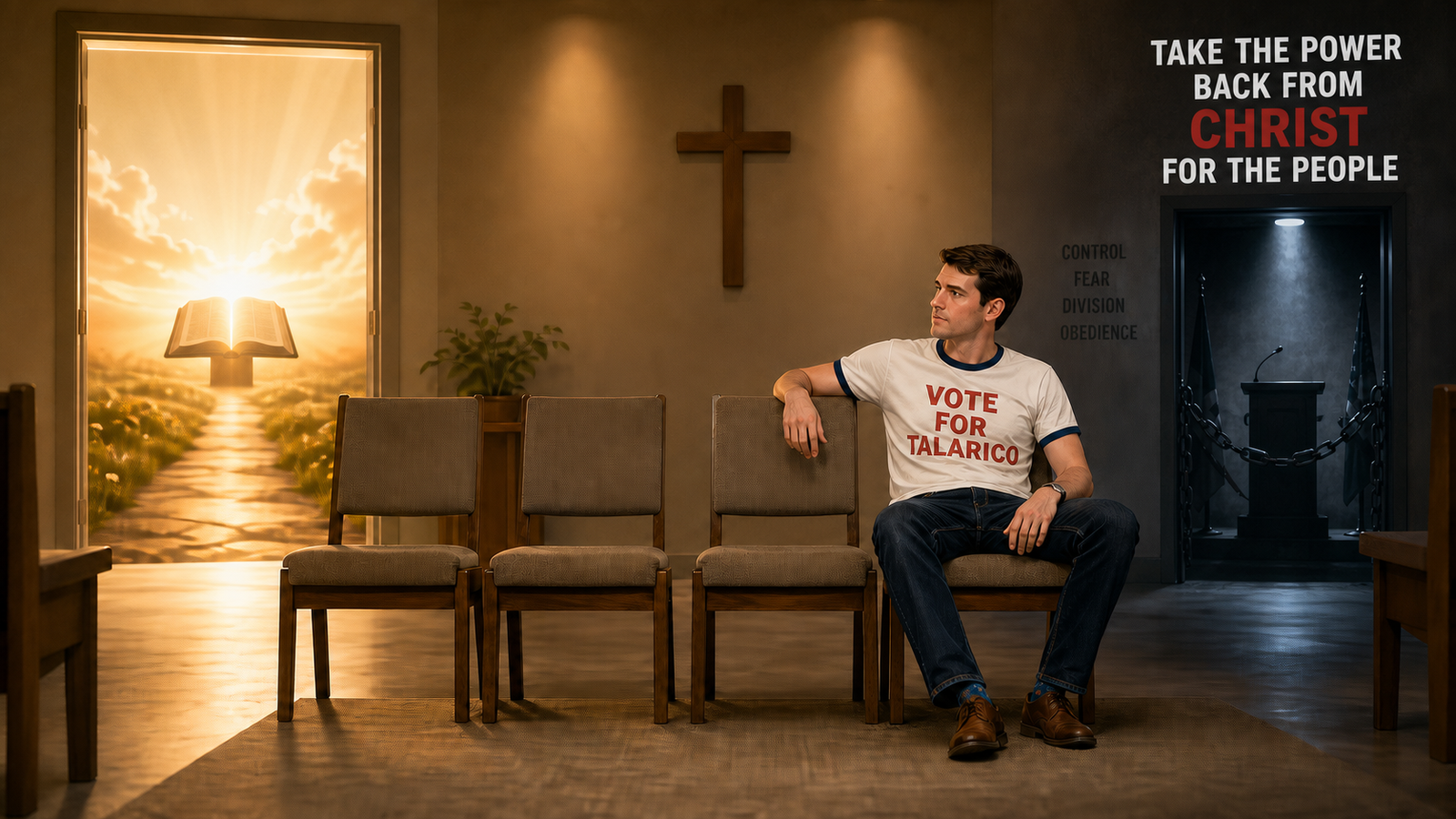
A lot of Americans are tired of angry, performative, and often hypocritical Christianity in public life. That critique is more than fair. Christians throughout history have given the world plenty of reasons for resentment because of the gap between what we preach and how we behave. But human hypocrisy does not cancel Truth. It reinforces our need and dependence on it.
So when a politician arrives who sounds thoughtful, gentle, and openly serious about faith, it is no surprise that people lean in. It is especially tempting when he seems to offer all the warmth of Christianity without the sharp edges of its truth, speaking the language of empathy, grievance, and healing while quietly filing down the parts of the Bible that confront our desires. This is part of why James Talarico, a Democratic Senate candidate from Texas who talks often about Jesus and justice, has become such a media talking point.
For voters exhausted by culture war slogans, cynical power games, and the religious noise machine, Talarico can sound like a relief. He speaks calmly. He talks about compassion. He presents himself as someone trying to rescue Christianity from people who have weaponized it. The appeal is obvious, especially when elite media frames him as someone who might "reclaim Christianity for the left." Watching that mix of sincerity, compassion, and rebranded religion is what brought an old Christian illustration back to mind, one that helps believers think honestly about how they relate to Jesus.
Adapted from a three-chair illustration popularized by Leif Hetland, the story pictures three chairs. The first is the seat of real commitment, the person who takes Christ seriously even when obedience is costly and who allows His words to correct their politics, preferences, and tribe. The second is the seat of compromise, the person who wants Christianity nearby but not in charge, faith as comfort but not as authority. The third belongs to the person who does not claim Christ at all and is honest about it.
The picture matters because it reveals where the real fault line actually runs. Not between "religious" and "secular," but between those who let Jesus define truth and those who try to edit Him. Watching Talarico praised as a kind of spiritual upgrade, it struck me that our moment has invented a fourth chair, one that borrows the language of the first but lives much closer to the second, and sometimes the third. In my earlier piece on Eva Peron and Alexandria Ocasio-Cortez, I argued that charismatic "voices of the people" can be used to capture institutions and soften resistance to an expanding state, wrapping hard-edged power in the language of care and justice. Talarico represents the same pattern in a different key: a religious frontman whose gentle, grievance-aware "faith" is being used to pull second-chair Christians and cultural Christians into a project that puts politics, not Christ, in the driver's seat.
The old three-chair picture needs an update. The fourth chair is not open unbelief. It is something more deceptive. It keeps the language of Jesus but not His authority, using Christian words, Christian symbols, and Christian concerns while slowly rewriting them to fit the spirit of the age. It presents a faith that feels compassionate, modern, and morally serious, while quietly removing the parts of Christianity that still have the power to confront us.
Understanding Talarico requires holding that frame clearly. The issue is not whether he sounds kind. The issue is whether the faith he presents still belongs to historic Christianity, or whether it has been edited into something more politically convenient.
The Fourth Chair: False Prophets in Sheep’s Clothing
Jesus warned His followers: "Watch out for false prophets. They come to you in sheep's clothing, but inwardly they are ferocious wolves." (Matthew 7:15) His point was not simply that obvious enemies of the faith are dangerous. Some of the most dangerous voices will look and sound like part of the flock. They will use the right language, carry the right symbols, and present themselves as helpers, all while leading people away from the Lord they claim to serve.
The fourth chair operates this way. It keeps the vocabulary of Jesus but not His authority. It talks about love, justice, and mercy, but treats those words as flexible tools to support whatever the age already wants, rather than as realities defined by God. And because it arrives with a soft voice and a concern for the vulnerable, it is especially attractive to those sitting in the second chair: Christians who are weary of conflict and looking for a faith that will never again put them at odds with the world.
The fourth chair promises them exactly that. It holds out a version of Christianity that sounds morally serious and emotionally warm, but almost never has to say "no" to the priorities of their party or their preferred movements. The only cost is surrendering the right of Jesus and Scripture to correct them when they are wrong.
This is why the fourth chair is more dangerous than open unbelief. The person in the third chair, who says plainly, "I am not a Christian," is at least honest about their distance from Christ. The person in the fourth chair may build an entire public identity around following Jesus while treating Him in practice as a mascot for their cause. They use His name, quote His words, speak often of His compassion, yet steadily hollow out His teaching until what remains is a reflection of their own politics and desires.
James Talarico is a high-profile example of this. He does not sound like the caricature of the angry religious right. He sounds like the opposite. He talks about love of neighbor, speaks against Christian nationalism, quotes the Gospels, and presents his campaign as an effort to bring a more "beautiful" Christianity into public life. On the surface, that is exactly what many disillusioned believers have been hoping to find.
The key question is not how gentle he sounds. The key question is what he does with the hard edges of Christian truth. When Jesus' teaching collides with the expectations of his party, his donors, or his cultural allies, does he submit to Christ, or does he revise Christ to fit the moment? As we will see in his own words about who God is, what the incarnation means, and how all religions relate to each other, Talarico's "reclaimed" Christianity looks far less like the first chair and far more like the fourth.
Reclaiming Christianity, Or Rewriting It?
Talarico and his admirers often describe his project as an effort to "reclaim Christianity for the left." The phrase sounds humble and restorative, as if Christianity is a neutral brand the right has stolen and the left is simply taking back. But the moment you say "reclaim," you have already assumed that the faith belongs first to a political tribe rather than to Jesus Himself.
Many Christians who feel politically homeless hear Talarico and think: Finally, someone who cares about the poor, opposes Christian nationalism, and still takes Jesus seriously. The implied promise is that this will not be a different religion, only a healthier expression of the same faith.
Listening closely, though, the pattern sounds less like reclaiming and more like rewriting. Talarico's public theology regularly takes the core claims of historic Christianity and bends them toward positions that have far more to do with modern progressive ideology than with the biblical text. He insists there is "no historical, theological, biblical basis" for saying Christians must oppose abortion, and argued on The Joe Rogan Experience that the Bible is "actually pro-abortion."
In each case, he uses familiar stories and phrases to advance conclusions that run directly against two thousand years of Christian teaching. The God who reveals Himself as Father is recast as "non-binary, both masculine and feminine and everything in between," language that mirrors contemporary gender theory more than the creeds. The incarnation, which the church has always treated as the holiest affirmation of life in the womb, becomes an argument for "reproductive rights." The uniqueness of Christ is softened into the claim that different religions are all "circling the same truth," flattening the hard edges of Jesus' own words about being the way, the truth, and the life.
This is not the language of a prodigal son returning to the Father's house. It keeps the tone of compassion and the appearance of spiritual depth while emptying Christian doctrine of its content and refilling it with the priorities of a political movement. In other words, exactly the kind of sheep's clothing Jesus warned us about.
“God Is Non‑Binary”: Recasting the Creator in Our Image
One of Talarico's most replayed moments came when he stood on the Texas House floor and declared, "God is both masculine and feminine and everything in between. God is non-binary." He framed it as a defense of transgender students, arguing that because humans are made in God's image and God transcends gender, Christians should affirm modern gender identities as reflections of the divine. He has since repeatedly defended the substance of the claim.
It is worth being fair here. Historic Christianity does teach that God is Spirit, and that both male and female together reflect His image. Scripture sometimes uses maternal imagery to describe God's care. In that limited sense, Christians have long acknowledged that God is above our categories.
But Talarico is doing something different. He is not simply saying God transcends gender. He is importing the vocabulary of contemporary gender ideology and laying it directly on top of the Creator, turning "non-binary" from a contested human identity claim into a divine attribute. In doing so, he reverses the direction of worship. Instead of letting God tell us who we are, he lets our age's categories tell us who God is. The God who revealed Himself as Father and taught us to pray "Our Father in heaven" is redefined to match the sensitivities of the moment, with authority flowing upward from culture to God rather than downward from God to culture.
For someone in the second chair, tired of being called intolerant, this can feel like relief: a version of God who will never embarrass you in front of enlightened friends, a God who always agrees with the latest vocabulary of inclusion. But a God who is continually revised to match our sensibilities is no longer the God of the Bible. He is a projection of the age. Jesus warned that false prophets would come dressed in sheep's clothing. One way that happens today is when leaders keep the outward form of Christian faith while introducing a God who has been stripped of the right to contradict us.
Using the Virgin Birth to Defend Abortion
On The Joe Rogan Experience, Talarico went further than most politicians dare. He claimed there is "no historical, theological, biblical basis" for saying Christians must oppose abortion and argued that the Bible is actually "pro-abortion." As supposed proof, he pointed to the creation of Adam, Jesus' treatment of women, and most striking of all, the story of the Annunciation.
In his telling, that scene proves that "creation has to be done with consent." The angel comes "and asks Mary if this is something she wants to do," and her response, "let it be done," shows that you "cannot force someone to create." From there, he argued that the most central story in Christianity supports a pro-choice ethic.
The problem is that the text does not say this, and two thousand years of Christian teaching have not read it this way. In Luke's Gospel, Gabriel does not arrive with a list of options. He announces what God will do: "You will conceive and give birth to a son." Mary does not negotiate terms. She asks how this will happen, then responds: "I am the Lord's servant. May it be done to me according to your word." God is not seeking permission from Mary. Mary is submitting to God. The church has always treated that moment as an example of obedience and trust, not as proof that creation is contingent on human consent.
Even more serious is what Talarico does with the core meaning of the event. For two thousand years, Christians have treated the incarnation as the clearest possible affirmation that the life in Mary's womb was already a real, living person, God the Son made flesh. The story is central to Christian pro-life arguments precisely because it portrays a child in the womb as fully human and fully precious. Talarico inverts that logic. He takes the holiest conception in history and uses it as a rhetorical tool to defend the killing of the most vulnerable lives. This is not a minor interpretive disagreement. It is a reversal of the story's entire moral thrust.
This is how the fourth chair operates. It keeps the story but flips its direction. It invokes the incarnation, one of the most sacred mysteries of the faith, not to call believers to worship and obedience, but to baptize a policy that the overwhelming majority of historic Christians, across traditions, have regarded as the deliberate taking of innocent life. It is hard to think of a clearer example of what it means to preach "another gospel" in the name of Christ.
All Paths, One “Beautiful” Truth?
Talarico's rebranding of Christianity does not stop with God's identity or the meaning of the incarnation. In his conversation with Ezra Klein and in other public comments, he repeatedly describes the world's major religions as "beautiful faith traditions" that are all "circling the same truth about the universe." While he says Christianity "points to the truth," he believes other "religions of love" point to the same destination, and he even suggests that religious symbols ought to "dissolve," like aspirin in water, into a shared mystical reality beneath them all.
On its face, this sounds humble and inclusive. Many modern listeners have been trained to hear any claim of religious uniqueness as arrogance and any suggestion that all paths are basically equal as open-minded and kind. For someone in the second chair who feels uneasy about saying Jesus is the only way, Talarico's language can feel like a spiritual sigh of relief.
Jesus and the apostles, however, did not speak this way. Jesus did not describe Himself as one of many lights. He said: "I am the way and the truth and the life. No one comes to the Father except through me." The great world religions make fundamentally conflicting claims about who God is, who Jesus is, what sin is, and how salvation works. They cannot all be true in the same way at the same time. Saying that Buddhism, Hinduism, Islam, Judaism, and Christianity are all "circling the same truth" is not an act of humility. It is a new doctrine that positions itself above every faith and corrects them all.
Talarico keeps the language of Christ and truth, but relocates final authority to a higher category he calls "mystery," a reality in which all sincere religious effort is basically equivalent. Christianity is no longer allowed to define itself on its own terms. It must fit inside a pluralist framework that treats any exclusive claim as suspect. Jesus ends up honored as an inspiring figure, perhaps even the clearest window into the divine, but not as the Lord who can tell other religions and other moral visions that they are wrong.
This same pattern surfaces when Talarico says he has met many Hindus, Buddhists, Sikhs, Jews, Muslims, atheists, and agnostics who are "more Christ-like" than some of his Christian colleagues in the Texas legislature. Christians can behave in deeply un-Christian ways, and Jesus Himself warned that not everyone who calls Him "Lord" belongs to Him. But in Talarico's telling, "Christ-like" collapses almost entirely into how people treat others in the public square, regardless of whether they believe what Christ says about Himself or submit to His authority. Being "like Christ" becomes a matter of civility and policy preferences rather than repentance, faith, and obedience.
God is reshaped to fit contemporary gender theory. The incarnation is repurposed to defend abortion. The uniqueness of Christ is dissolved into a generic spiritual mystery. And "Christ-likeness" is defined by a certain style of politics rather than by following Jesus as Lord. This is not a different emphasis within orthodoxy. It is a different faith, one that uses the words of Christianity to advance a vision that historic Christianity has consistently denied.
The Spiritual Cost: When “Lord, Lord” Is Not Enough
Jesus did not only warn about wolves in sheep's clothing. He also warned about people who would build entire lives and ministries in His name and still find themselves shut out of His kingdom: "Not everyone who says to me, 'Lord, Lord,' will enter the kingdom of heaven, but only the one who does the will of my Father who is in heaven. Many will say to me on that day, 'Lord, Lord, did we not prophesy in your name...?' Then I will tell them plainly, 'I never knew you. Away from me, you evildoers.'" (Matthew 7:21-23)
The people Jesus describes are not atheists or open enemies of the church. They are people who speak His name, claim to act for Him, and see themselves as part of His movement. Their problem is not a lack of religious language. It is a lack of actual submission. They did many things "for Jesus" but never let Jesus' words define what obedience actually meant. They corrected Him instead of letting Him correct them.
This is not just a disagreement about policy or a quarrel inside the big tent of Christian opinion. It is a question of spiritual life and death. If someone embraces a version of Christianity that denies the uniqueness of Christ, recasts God to fit the latest theories, repurposes the incarnation to defend the shedding of innocent blood, and treats "Christ-likeness" as a matter of social style rather than repentance and obedience, no amount of "Lord, Lord" rhetoric will save them.
Jesus does not sort people at the judgment based on party registration. He warns that not everyone who calls Him Lord will enter His kingdom, only those who actually do the will of His Father. The question for every admirer of Talarico is simple: when Christ contradicts you, do you change, or does He?
The Political Cost: Grievance Wrapped in a Cross
Fourth-chair faith does not only carry spiritual consequences. It also reshapes politics. In Talarico's case, the faith he describes functions as a moral soundtrack for a very familiar script, one built around a constant oppressed-versus-oppressor narrative in which his side is always on the side of the crucified and his opponents are always playing Rome. He speaks often of "billionaires destroying our democracy," frames his Senate run as a battle against a "billionaire class," and casts his campaign as a fight to liberate the poor from the grip of economic and cultural elites.
There is nothing inherently wrong with criticizing concentrated power. Scripture is full of warnings to the rich who exploit the weak. The problem comes when these categories harden into a worldview where the main question is always "Who is the oppressor?" rather than "What does obedience to Christ require?" In that framework, Jesus becomes less a Savior who confronts every tribe and more a mascot who blesses whichever coalition has successfully claimed the victim mantle in a given moment.
In practice, Talarico's rhetoric divides the world into those whose politics align with his, who are therefore "Christ-like," and those who resist his agenda, who are therefore unloving or anti-Christian. The cross gets painted on one side's banner to give that power a halo.
When believers adopt this pattern, they are tempted to treat alignment with a particular economic or social program as the primary test of faithfulness. Brothers and sisters in Christ who raise serious biblical objections can be dismissed as "on the side of the oppressor," regardless of their actual motives. Meanwhile, nonbelievers who agree with the program get praised as "more Christ-like" than the church itself, even if they openly reject Jesus' claims about Himself. The result is not unity or justice. It is a new kind of tribalism, one in which the kingdom of God is quietly reduced to the platform of a political movement.
The fourth chair does not merely invite people into a different style of Christianity. It invites them to fuse their faith with a particular narrative of grievance and power, then treat any challenge to that narrative as an attack on Jesus Himself. In the process, it trains them to choose their party over their Lord whenever the two come into conflict. Few trades are more costly, both for the soul and for the witness of the church.
Which Chair Are You In?
At this point, it is easy to keep the spotlight on James Talarico. But Jesus' warnings were never meant to be aimed only at other people. They are invitations to self-examination. The four chairs are not categorizes for politicians and public figures. They are mirrors for the rest of us.
If you are in the first chair, you will not always get it right. You will sin, stumble, and sometimes find yourself badly out of step with what you claim to believe. But when Christ confronts you, you repent. You let His Word correct you. You accept that He is Lord and you are not. If you are in the second chair, you keep Him nearby but reserve the final veto for yourself. You may quote Jesus, attend church, and nod along to sermons, but when His teaching threatens your status, your comfort, or your cause, you quietly slide back.
The fourth chair adds the most dangerous possibility of all. It invites you to resolve the tension by changing the definition of obedience. Instead of saying "I am wrong and Jesus is right," you say "Jesus never really meant that" or "a loving Jesus would agree with what I already believe." You keep His name and discard His authority. You no longer need repentance because you no longer believe you are wrong. In that chair, you can feel very pious, very compassionate, very modern, and still hear Him say at the end: "I never knew you."
The purpose of this piece is not to tell you that voting for James Talarico automatically puts you in the fourth chair. The purpose is to warn you that the faith he models is built to make the fourth chair feel like the safest and most reasonable place to sit. It presents Christian language without the cost of Christian obedience, spiritual community without the risk of being corrected by Christ, moral passion without the humility of repentance.
So the question is not only, "What do you think about Talarico?" The deeper question is, "What do you do when Jesus disagrees with you?" Do you let His words confront your views on life in the womb, on sexuality, on money, on enemies, on truth? Or do you search for a teacher, a politician, or a "new" Christianity that will reassure you, based on your own standards, that He is always on your side?
Your vote will matter for a few years. Your soul will matter forever. Do not trade your walk with the Jesus who created you for a Jesus YOU created.
Sources
- James Talarico's progressive Christianity and the Texas Senate race — The Texas Tribune
- Can James Talarico Reclaim Christianity for the Left? (The Ezra Klein Show) — DNYUZ
- NY Times: Can Texas Senate Candidate Talarico Reclaim Christianity for the Left? — TaxProf Blog
- "God Is Non-Binary": Talarico's Past Remarks on Abortion, Race, and Gender — Fox News
- Talarico Doubles Down on "God Is Beyond Gender" Comments — Fox News
- Fact Check: "God Is Non-Binary" — Talarico's 2021 Texas House Speech — Snopes
- Talarico Claims Atheist Colleagues Are "More Christ-Like" — Christian Post
- Texas Dem Says Atheists Are More "Christ-Like" Than Christian Colleagues — Fox News
- Explaining James Talarico's Theology — Denison Forum
- The Three Chairs Illustration — Leif Hetland Ministries
- Leif Hetland, Called to Reign: Living and Loving from a Place of Rest (2018) — Amazon
- Holy Bible, Matthew 7:15; Matthew 7:21-23; Luke 1:26-38; John 14:6 (NIV)
Disclosure: The ideas, arguments, and conclusions in this piece are the author’s own. AI was used for research, fact-checking, editing, and production under the AI Use Policy.
Get The Sovereignty Ledger by email
Free. One essay at a time. Unsubscribe whenever.
Get the next essay by email
Free. One essay at a time. Unsubscribe whenever.