How the 17th Amendment Fueled Executive Expansion and Shattered the Genius of the Founders
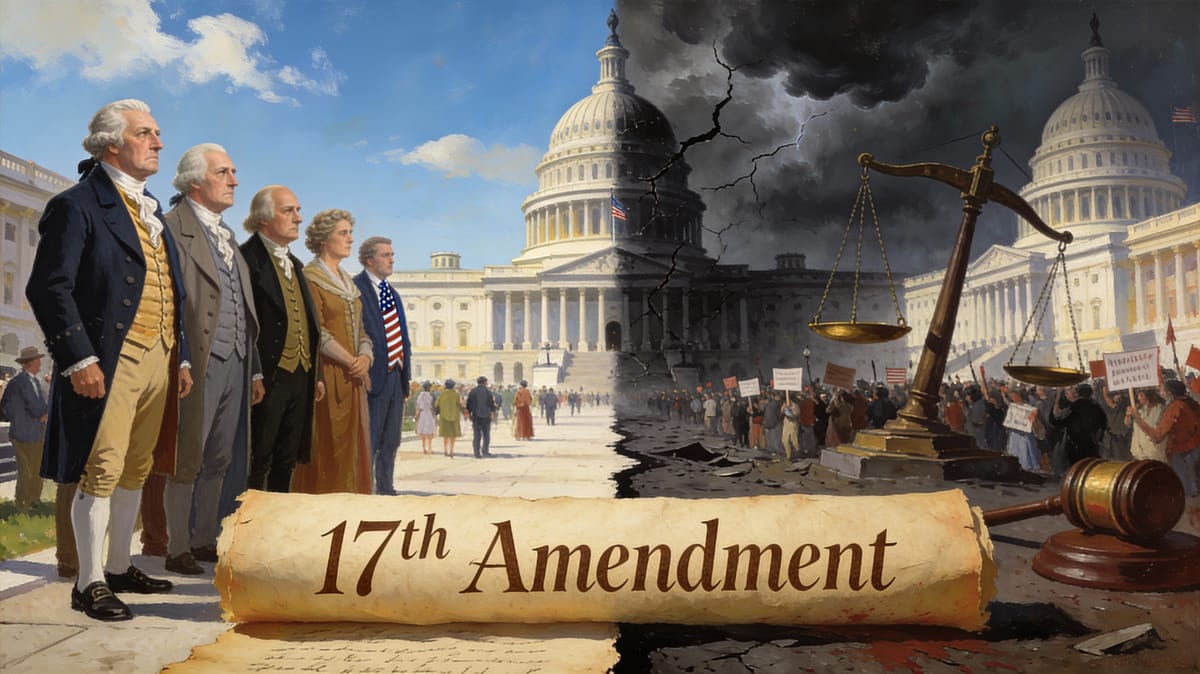
The 17th Amendment broke America's federalist system by eliminating state representation in the Senate. Direct election of senators destroyed the constitutional check on federal power, fueling executive expansion, partisan gridlock, and the administrative state. Time to fix what Progressives broke.

Arizona Republicans just introduced a resolution to repeal the 17th Amendment. Cue the outrage: "They're taking away your right to vote for senators!" "This is anti-democratic!"
WTF?? House Republicans just introduced a measure to REPEAL the 17th Amendment of the US Constitution. They want to ban the people from voting for our US Senators. Instead, they want the Legislature to appoint our Senators.
— Rep. Oscar De Los Santos (@RepODLS) January 28, 2026
WTF are they thinking? pic.twitter.com/r2EROiqI7j
Here's what they're actually doing: trying to fix a century-old mistake that broke the constitutional system and gave us the dysfunctional mess we have today.
When you think of American government in the year 1913, you think Jekyll Island, the Fed, and inflation. But that same year gave us something arguably worse: the 17th Amendment, which replaced state legislative appointment of senators with direct popular election. 17A didn't make headlines then, but it literally broke America's federalist order—and we're still paying the price.
What Actually Broke
The population already had federal representation—in the House. That was the point of population-based districts.
The Senate was something different. States were supposed to have a seat at the federal table as the sovereign entities they were. Senators appointed by state legislatures gave states an institutional voice in federal decisions. The Senate was the state's check on federal authority.
The 17th Amendment destroyed that check. States lost any meaningful leverage over the federal government. And what happened next? The federal government grew like a cancer—especially in the form of so-called "independent agencies" that now make law without Congress, enforce law without the executive branch's direct control, and adjudicate law without the judiciary.
The administrative state exists because the Senate stopped defending state sovereignty. That wasn't an accident. It was the inevitable result of changing the incentive structure.
What the Founders Actually Said
The Founders weren't subtle about why state legislatures should appoint senators.
James Madison in Federalist No. 62: Appointment by state legislatures gives "to the state governments such an agency in the formation of the federal government as must secure the authority of the former; and may form a convenient link between the two systems."
That word "must" wasn't casual. State appointment didn't just connect the systems—it was supposed to secure state authority against federal overreach. That was the entire point.
Roger Sherman at the Constitutional Convention, June 11, 1787: The Senate should defend "the rights and interests of the states." Each state "ought to be able to protect itself: otherwise a few large States will rule the rest."
Not a preference. A constitutional necessity. States needed institutional protection within the federal system. The Senate was that protection.
The delegates unanimously agreed on June 7 that state legislatures would choose senators. It wasn't controversial—it was considered essential to the federal structure.
Madison explained the Senate's role: "proceeding with more coolness, with more system, and with more wisdom, than the popular branch" of Congress. That required different selection mechanisms and different accountability structures.
The Founders understood something we've forgotten: institutional design creates incentives. Incentives drive behavior.
When senators answered to state legislatures, they had institutional reasons to defend state sovereignty, resist federal overreach, and work across party lines on state interests.
When senators chase statewide popular votes instead? Those incentives disappear. And the federal government, that they were supposed to check... just keeps growing.
How'd the Founders Intend for the System to Work?
Before 1913, a senator appointed by a state legislature had to balance competing pressures: the political makeup of the legislature, state governmental interests, regional concerns, national policy questions.
This created coalitions that didn't map onto national party divisions.
A Democratic senator from a manufacturing state might ally with a Republican from another manufacturing state on tariffs—party didn't matter. A Republican from a Western state might join Democrats on public lands that affected state sovereignty.
State interests created cross-pressures that fractured rigid partisanship.
Then the 17th Amendment shattered this. Senators elected by popular vote started responding to the same nationalized coalitions that elect House members.
State interests became secondary to party loyalty. The moderating function disappeared. And states lost their institutional voice in the only place it mattered.
What Actually Happened After Direct Election
Under direct election, Senate races became nationalized partisan competitions, not state-focused representation.
Senators need massive money for statewide campaigns. That money comes from national party organizations, ideological PACs, out-of-state donors who care about national issues—not state sovereignty.
The incentives are crystal clear: align with national party positions or get primaried. A Republican who breaks with the party gets challenged from the right. A Democrat who defends state interests over party orthodoxy faces progressive challengers.
Moderation gets punished. Partisan rigidity gets rewarded.
State-appointed senators would face completely different pressures. State legislatures include urban and rural districts, different economic interests, competing regional priorities. A senator answerable to a legislature has to build coalitions within it—requiring compromise.
More importantly, state legislatures care about state interests, not national talking points. A legislature facing unfunded federal mandates wants a senator who fights those mandates regardless of which party controls Washington.
That's why Senate polarization has increased dramatically since 1913. Not just cultural change or media fragmentation—structural consequence of replacing state-focused representation with nationalized partisan elections.
The Senate stopped moderating conflict because it stopped having institutional reasons to moderate conflict.
The Real Problem: Executive Power Went Unchecked
Here's the connection everyone misses: the 17th Amendment didn't just polarize the Senate—it destroyed the Senate's ability to check executive power.
The explosion of executive authority over the past century—the administrative state, executive orders with legislative effect, regulatory agencies controlled by the president, endless emergency declarations—became possible because the Senate stopped functioning as an institutional check.
Why? Senators elected by the same coalitions that elect presidents have weak incentives to check presidents from their own party.
Republican president issues controversial executive orders? Republican senators face pressure from the same base to support them.
Democratic president expands executive authority? Democratic senators defend it to maintain party unity.
State-appointed senators would face totally different calculations. State legislatures don't care if the president is from their party—they care if executive actions threaten state sovereignty or impose costs on the state.
A Republican legislature would pressure senators to oppose a Republican president's overreach if it violated state prerogatives. A Democratic legislature would demand senators check a Democratic president ignoring state interests.
Look at the administrative state. Federal agencies make rules with the force of law, often without meaningful congressional input. EPA regulates state land use. Department of Education dictates state education policy. OSHA imposes workplace mandates on state employers.
All through executive branch action the Senate fails to check.
A Senate of state-appointed members would have blocked this systematically. State legislatures don't want federal agencies preempting state law. They would have demanded senators vote against executive nominees supporting federal overreach, reject budgets funding intrusive agencies, pass legislation restraining administrative power.
Instead? The Senate rubber-stamps executive expansion when their party controls the White House and engages in performative opposition when they don't.
The executive branch grows regardless of which party wins elections. That's not a bug in the post-17th Amendment system—it's a feature.
The Federal Funding Trap
The 17th Amendment created another problem fueling both executive power and dysfunction: federal funding dependency.
Federal funding is roughly 33% of state revenues today. This isn't benevolence—it's control.
Federal dollars come with federal strings: mandates, regulations, policy requirements. States become administrative arms of federal programs rather than sovereign entities.
Senators elected by popular vote have every incentive to support this. Bringing federal money home is good politics—voters like "free" federal dollars for roads, schools, healthcare. The strings constraining state sovereignty don't show up in campaign ads.
State legislatures see this differently. They understand federal funding creates policy constraints, administrative burdens, long-term dependency.
A senator appointed by a state legislature would face direct pressure to oppose funding schemes trading sovereignty for temporary budgetary relief.
This matters for executive power because the executive branch administers these programs. When states depend on federal dollars distributed through executive agencies, the president gains massive leverage over state policy.
Don't want to implement the president's preferred policy? Fine—lose your highway funding, Medicaid dollars, education grants.
State-appointed senators would give states a tool to fight back: vote against federal programs with unacceptable strings, knowing the legislature supports defending sovereignty over accepting dependent status.
The current system makes this politically impossible for popularly elected senators. Which is exactly why the federal government prefers it this way.
These Problems Are Connected
Polarization and executive overreach aren't separate crises—they're linked consequences of breaking the Senate's original design.
When the Senate became a partisan body elected through nationalized campaigns, it lost the institutional independence needed to check executive power. Senators from the president's party defend overreach to maintain party unity. Opposition senators engage in performative opposition without structural tools to restrain action.
The same partisan nationalization prevents the Senate from moderating conflict. Without cross-cutting coalitions based on state interests, the Senate reinforces partisan polarization instead of mitigating it.
State appointment addresses both simultaneously. Senators answerable to state legislatures have institutional incentives to check executive power regardless of party—state sovereignty matters whether the president is Republican or Democrat. They also have incentives to build cross-party coalitions around state interests.
That's the moderation the Founders intended. That's the check on federal power they designed. The 17th Amendment destroyed both.
The Constitutional Hypocrisy
Here's what's remarkable: many opposing repeal claim to celebrate American constitutional genius. They'll praise the Founders' wisdom, the brilliance of our system, American exceptionalism.
Then propose returning to the constitutional design the Founders actually created, and suddenly that design is undemocratic, outdated, dangerous.
The inconsistency is obvious. Their reverence for the Constitution extends exactly as far as the current system protects their power.
They love the Founders' wisdom in the abstract. They oppose originalist reforms that would constrain federal authority or limit their leverage over policy.
Constitutional respect as performance art—honoring the document in speeches while rejecting its actual requirements when those requirements become inconvenient. It's treating the Constitution like a museum piece to admire rather than a binding framework to follow.
Many claiming to defend democracy are really defending their own power. Direct election of senators serves national party organizations, federal bureaucracies, special interest groups, media operations profiting from nationalized conflict.
Returning to state appointment would disrupt those power centers by reintroducing genuine federalism as a check on centralized control.
Of course they oppose it. The question is whether the rest of us will keep accepting their constitutional hypocrisy.
Addressing the Objections
"This is undemocratic—you're taking power from voters!"
No. State legislators are elected by the people. When they appoint senators, they exercise authority delegated by voters who can hold them accountable in the next election.
The Founders deliberately rejected pure democracy for a constitutional republic with multiple layers of representation. Madison defended indirect election of senators in Federalist No. 63 as essential to the Senate's role.
If direct popular election is inherently superior, why not elect Supreme Court justices, cabinet members, federal judges by popular vote?
Different institutions serve different functions. Those functions require different selection mechanisms. The Senate was designed to represent states as states—not to be a second House of Representatives.
"Repeal won't fix polarization or executive overreach."
Not overnight. But it changes the structural incentives producing both problems.
Senators accountable to state legislatures rather than nationalized party bases have institutional reasons to work across party lines on state interests. They have structural incentives to check executive power regardless of which party controls the White House.
Over time, different incentives produce different outcomes.
The current system has been failing for over a century. Structural problems require structural solutions.
"This will never pass—why waste time?"
Constitutional amendments require sustained argument and long-term coalition building. Conservatives spent decades building the case for originalism before it transformed the Supreme Court.
Arizona's resolution joins efforts from other states forcing this conversation into public debate.
This objection assumes political reform is only worth pursuing if immediate victory is guaranteed. That's not how constitutional change works. The case must be made, arguments developed, coalition built.
Dismissing the effort before it begins guarantees current dysfunction continues indefinitely.
Why This Matters Now
The dysfunction is undeniable. Hyperpartisan gridlock, unchecked executive power, federal overreach, state dependency—these aren't separate problems requiring separate solutions.
They're connected consequences of breaking the constitutional structure designed to prevent them.
The 17th Amendment promised to make the Senate more democratic and responsive. Instead, it produced a body serving national party organizations, failing to check executive overreach, amplifying polarization, maintaining approval ratings below 30% while presiding over an executive branch that grows regardless of which party wins elections.
Restoring state appointment of senators isn't radical—it's originalist. It doesn't reduce democracy—it changes incentive structures to produce the moderation and executive restraint the Founders intended.
Every state legislature should consider resolutions like Arizona's. Every conservative serious about limiting executive power and reducing dysfunction should ask: Do you support returning to the Founders' design or maintaining the Progressive Era's failed experiment?
The 17th Amendment didn't just break federalism. It broke the institutional mechanisms designed to prevent partisan polarization and executive tyranny. It removed states' seat at the federal table and left them with no meaningful check on federal authority.
Those claiming to celebrate American constitutional exceptionalism while opposing restoration of that constitutional design are revealing their respect for the Founders extends only as far as it protects their own power.
Time to call that bluff. Time to fix what the Progressives broke. Time to restore the constitutional order that made American exceptionalism possible.
Sources
- KJZZ: Arizona House Republicans propose measure to restore legislature picking U.S. senators
- The Source: Trump-backed GOP revives push to abolish 17th Amendment
- Constitution Center: Repealing the 17th Amendment would be no small task
- U.S. Senate: The Seventeenth Amendment
- Founders Online: Federalist No. 62 by James Madison
- U.S. Senate: Idea of the Senate
- U.S. Senate: Equal State Representation
- Heritage Foundation: Would Repealing the 17th Amendment Revive Federalism?
- Heritage Foundation: Some Conservatives Want to Repeal the 17th Amendment. Here's Why They're Right
- LONANG Institute: The 17th Amendment—A Fault and Recommendation
- ALEC: A Restoration of the Constitutional Intent of Our Founding Fathers
- TrackBill: Arizona HCM 2010 Status
- Wikipedia: Seventeenth Amendment to the United States Constitution
- Wikipedia: Constitutional Convention (United States)